
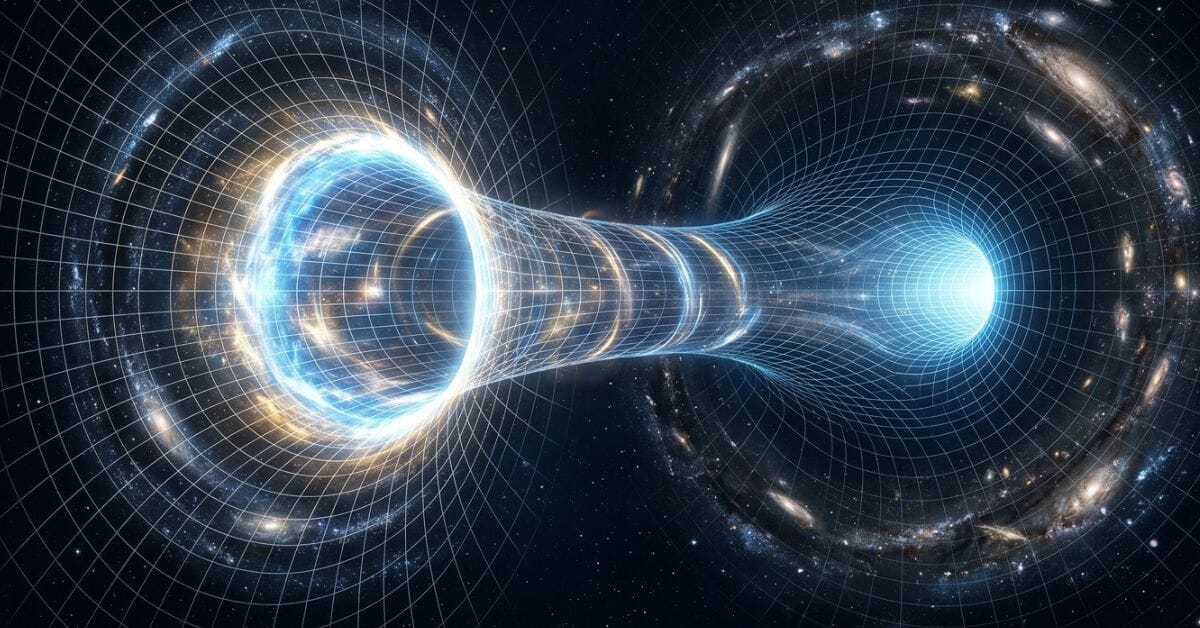
Is It Possible to Make a Time Machine? If you've ever wondered whether a time machine could actually be built, you're asking a question that serious physicists have spent decades trying to answer, not science fiction writers. The honest answer isn't a simple yes or no. Part of it is already proven and happening right now, in orbit above your head. The other part runs into some of the strangest walls in modern physics.
This article breaks down exactly what's real, what's theoretical, and what's pure fiction using the same physics that governs GPS satellites, black holes, and the structure of spacetime itself.
Table of Contents
What Is a Time Machine?
That definition splits into two very different problems:
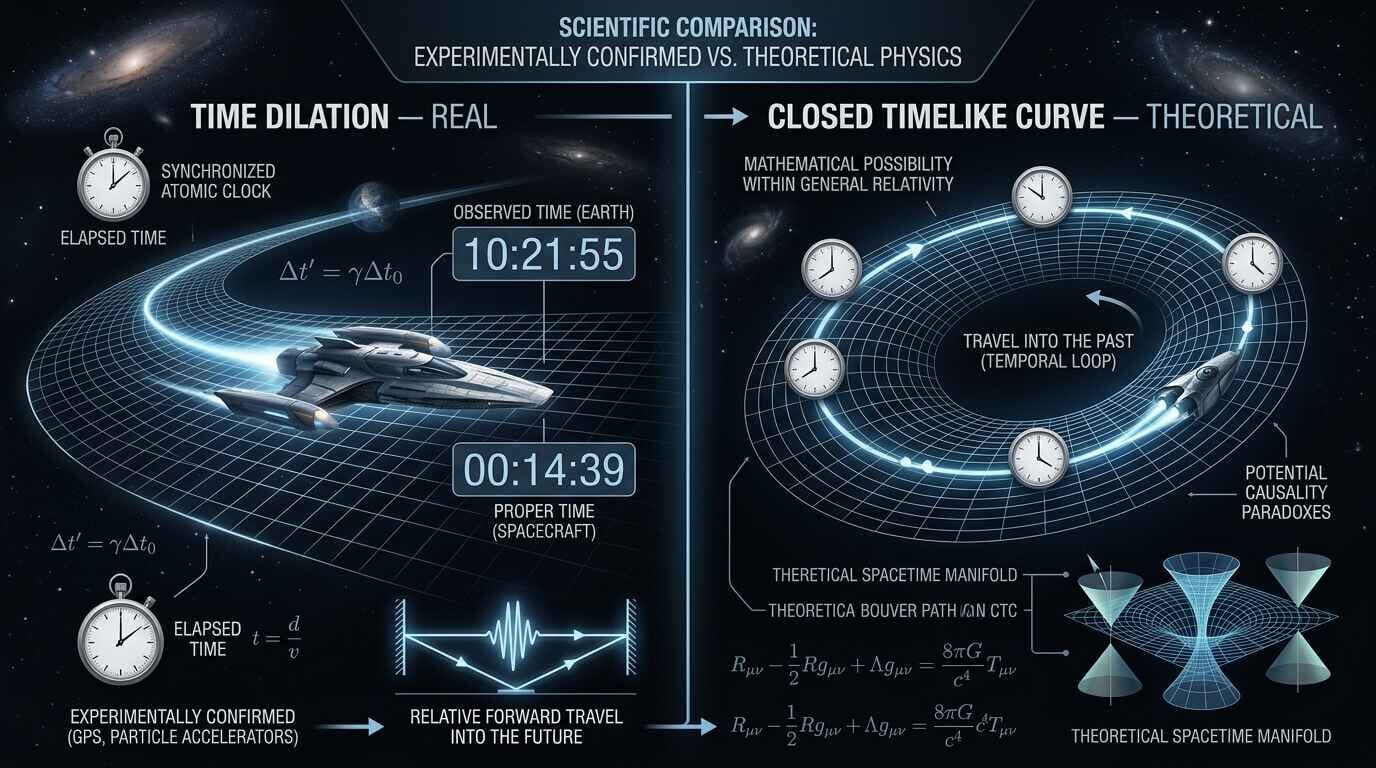
- Forward time travel (into the future): This is real. It happens whenever something moves fast enough or sits in a strong enough gravitational field, because time itself passes at a different rate for it compared to someone else.
- Backward time travel (into the past): This is the version most people mean when they say "time machine." It has no confirmed physical mechanism. It shows up as a mathematical possibility in general relativity, but turning that math into an actual, working device is a completely different problem.
It's worth being precise here because a lot of confusion online comes from blending these two ideas together. Relativity's predictions have been confirmed repeatedly through experiment, and they're not just academic; satellite navigation systems like GPS and Galileo depend on accounting for them every day. That's forward time travel, and it's not speculative at all.
Backward time travel is the harder question, and it's the one this article focuses on most closely.
How Does Time Travel Actually Work?
Forward time travel: time dilation
Albert Einstein's theory of relativity showed that time is not a fixed, universal clock ticking the same way for everyone. Instead, time passes at different rates depending on two things: how fast you're moving, and how strong the gravity is around you.
This is called time dilation, and it comes in two flavors:
- Special relativity (velocity-based): The faster you move relative to someone else, the slower your clock runs compared to theirs.
- General relativity (gravity-based): The stronger the gravitational field you're in, the slower your clock runs compared to someone farther from that mass.
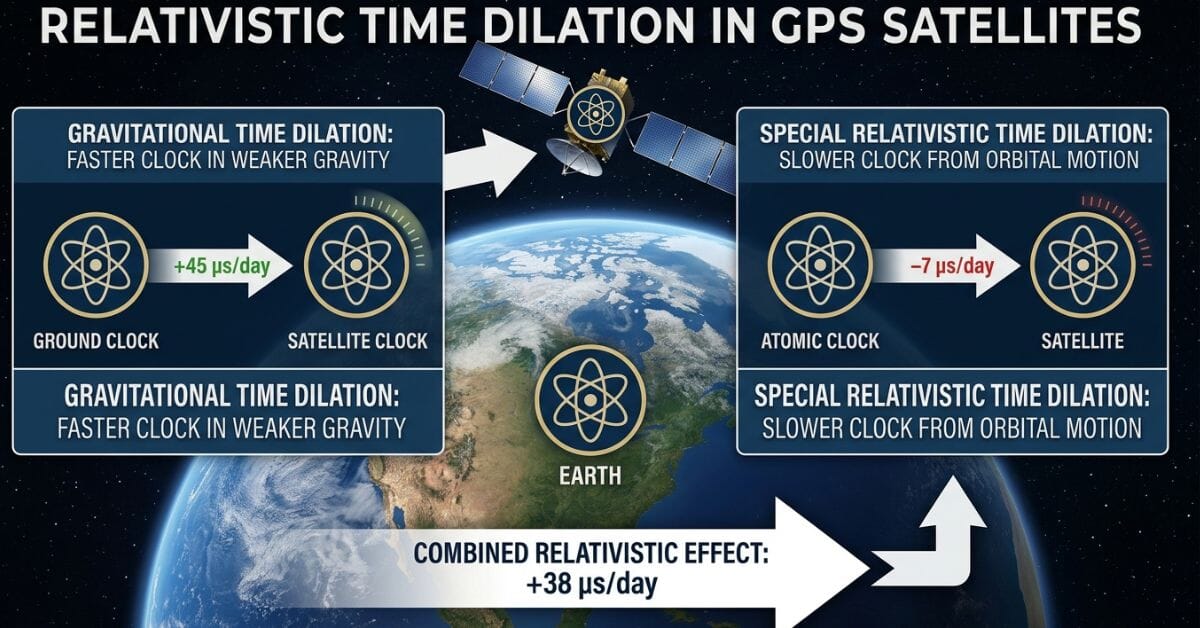
A concrete, verified example: as documented in Ohio State University's "Real-World Relativity" project, special relativity predicts that the onboard atomic clocks on GPS satellites should fall behind clocks on the ground by about 7 microseconds per day because of their relative motion, while general relativity predicts the opposite effect — because the satellites orbit where Earth's gravitational pull on spacetime is weaker, their clocks should run about 45 microseconds per day faster than clocks on the ground. The combined result is that GPS satellite clocks gain roughly 38 microseconds daily compared to clocks on Earth — and if engineers didn't correct for it, that drift would cause a GPS positioning error of about 10 kilometers.
Astronauts experience the same effect on a much smaller scale. After six months aboard the International Space Station, an astronaut returns having aged a few milliseconds less than someone who stayed on Earth — a real, measured version of forward time travel, just too small to notice without an atomic clock.
Scale that effect up. If you could travel close to the speed of light, time dilation becomes dramatic rather than microscopic. A trip that feels like one year to you could correspond to ten or more years passing on Earth. That's not fiction — it's a direct, tested prediction of special relativity. The technology to reach those speeds simply doesn't exist yet.
Backward time travel: the much harder problem
Traveling to the past requires something different: a path through spacetime that loops back on itself, known to physicists as a closed timelike curve (CTC).
Here's the key nuance most articles skip: closed timelike curves are not forbidden by the equations of general relativity. As Scientific American reports, Kurt Gödel proved in 1949 that closed timelike curves are completely consistent with the equations of general relativity, and the laws of physics do not rule out traveling to the past — at least mathematically, in specific and unusual models of the universe (like one that is rotating, which ours does not appear to be).
Physicists have explored a handful of theoretical routes to a closed timelike curve:
- Traversable wormholes: In 1988, physicist Kip Thorne and colleagues found a new kind of solution to Einstein's field equations describing traversable wormholes that would allow time travel in realistic models of the universe, reigniting scientific interest in the topic.
- Cosmic strings: Hypothetical, extremely dense, thread-like defects in spacetime that some theorists proposed could be manipulated to create a closed timelike curve.
- Rotating universes and exotic metrics: Mathematical solutions (like the Gödel universe or the Kerr metric describing rotating black holes) that permit closed timelike curves under very specific, non-realistic conditions.
None of these have ever been demonstrated, built, or observed. They exist as solutions to equations — not as engineering blueprints.
Why Is It Possible to Make a Time Machine Question Matters
This isn't just a fun thought experiment. The physics behind time machines connects directly to some of the biggest open questions in science:
- It tests the limits of general relativity. Figuring out why time machines might be impossible (or why they might not be) helps physicists understand where Einstein's equations break down and where a deeper theory — one that unites relativity with quantum mechanics — is needed.
- It has real, everyday applications. The same time dilation math that makes forward time travel real is the reason your phone's GPS can pinpoint your location within a few meters instead of drifting by miles.
- It shapes future space travel. As missions to Mars and beyond become more realistic, understanding time dilation becomes part of practical mission planning, not just theory.
- It clarifies popular culture claims. A lot of viral claims about "real time machines" or leaked government time travel projects are pseudoscience. Understanding the actual physics is the best defense against being misled by them.
Main Types, Methods, and Proposed Mechanisms
Time dilation devices (forward time travel only)
These aren't "machines" in the sci-fi sense — they're the by-product of speed and gravity. Any spacecraft, high-speed particle, or object near a massive body experiences this. It's proven, measurable, and already used in engineering (GPS being the clearest example).
Wormhole-based time machines (theoretical)
A wormhole is a hypothetical tunnel connecting two distant points in spacetime. If one end of a wormhole were moved at high speed or placed in a strong gravitational field relative to the other, time dilation could cause the two ends to become offset in time — in theory, turning it into a path to the past as well as a shortcut through space.
The catch: both general-relativity theory and quantum theory appear to offer several possibilities for traveling along a closed, timelike curve or "time machine," but scientists' current understanding of the laws of physics is described by researchers as "infested with time machines" in the mathematical sense — meaning the math allows many exotic solutions without any of them being physically achievable with real materials or energy.
Keeping a wormhole open and stable would require "exotic matter" with negative energy density — something that has never been observed to exist in usable quantities.
Cosmic string time machines (theoretical, effectively ruled out)
This is one of the most carefully studied — and most clearly rejected — proposals. MIT physicist Eddie Farhi, director of the university's Center for Theoretical Physics, examined a proposal by Princeton astrophysicist J. Richard Gott to use cosmic strings to build a time machine. Farhi and his MIT colleagues discovered that such an object could not actually be constructed because doing so would require more than half of the energy in the entire universe.
Even setting energy aside, it was later shown that if such a device were somehow built, the universe would end in a "Big Crunch" before a time traveler could complete a voyage into the past. As Farhi put it plainly: "it really seems that time travel cannot happen."
Rotating black holes and Gödel-style universes (mathematical curiosities)
Certain exact solutions to Einstein's equations — including rotating black hole models and Gödel's 1949 rotating-universe model — mathematically contain closed timelike curves. But these solutions describe universes or conditions that don't match the one we actually live in (our universe shows no evidence of the large-scale rotation Gödel's model requires).
Step-by-Step: How Physicists Actually Evaluate a "Time Machine" Proposal
If you wanted to seriously assess whether any time machine concept holds up, this is roughly the process physicists follow:
- Check consistency with general relativity. Does the proposed structure (wormhole, cosmic string, rotating mass) satisfy Einstein's field equations at all? Many early sci-fi concepts fail here immediately.
- Check the energy requirements. Does building or maintaining the structure require negative energy, exotic matter, or an unrealistic amount of ordinary energy? This is where most proposals — like Gott's cosmic string idea — collapse.
- Check for paradoxes. Would the mechanism allow a "grandfather paradox" (changing the past in a way that prevents itself from happening)? If so, physicists look for a self-consistency principle that would prevent the paradox from ever occurring in the first place.
- Check for chronology protection. Does some undiscovered law of physics step in to prevent the time machine before it can ever form? Stephen Hawking proposed this exact idea.
- Look for experimental or observational evidence. Has anything like this been observed in nature — a naturally occurring wormhole, a rotating universe, or unexplained causality violations? So far, the answer is no.
A common mistake is stopping at step 1 and assuming that because the math "works," the device is buildable. Steps 2 through 5 are where nearly every serious time machine proposal has failed.
Benefits (Of Understanding This Physics Not of Time Travel Itself)
It's worth being clear: there's no working time machine to a past, so there are no real-world benefits of using one yet. But studying the question seriously does have genuine value:
- Improves navigation technology. Time dilation corrections are essential for GPS, satellite communication, and future deep-space navigation.
- Deepens our understanding of gravity and causality. Studying closed timelike curves forces physicists to sharpen their understanding of cause and effect at a fundamental level.
- Informs future long-duration spaceflight planning. Time dilation becomes non-negligible for high-speed, long-distance missions, and needs to be accounted for in mission clocks and communications.
- Separates real physics from pseudoscience. Understanding what's actually established versus purely speculative helps the public evaluate viral "time travel" claims critically.
Limitations and Risks
Even in the most optimistic theoretical framing, a real time machine to the past faces serious, currently unsolved obstacles:
- Energy requirements are, in known proposals, unrealistic. The cosmic-string proposal alone would need more than half the total energy in the observable universe.
- Exotic matter with negative energy has never been confirmed to exist in any form usable for holding a wormhole open.
- Hawking's chronology protection conjecture suggests that physical laws we haven't yet discovered may specifically prevent time machines from forming, based partly on the observation that "we have not been invaded by hordes of tourists from the future."
- Causality paradoxes remain philosophically and physically unresolved. Even where physicists propose self-consistency principles to avoid paradoxes, none of this has been tested against reality.
- No time machine, prototype, or working mechanism has ever been observed, built, or verified by any credible scientific institution.
Given all this, most physicists today treat backward time travel as extremely unlikely to ever be physically realized, even though it isn't strictly mathematically forbidden.
| Factor | Time Machine (Physics Concept) | Time Machine Watch (Consumer Product) |
|---|---|---|
| Purpose | Theoretical device or process for traveling forward or backward in time | Wristwatch or novelty item, often themed around time travel, science fiction, or vintage design |
| Scientific basis | Grounded in general relativity, time dilation, and closed timelike curve theory | None — purely aesthetic or thematic |
| Cost | Currently unbuildable; theoretical designs would require unrealistic or nonexistent resources | Ranges from roughly $15–$300+ depending on brand and design |
| Difficulty | Unsolved by physics; possibly impossible | None — it's an off-the-shelf consumer product |
| Real-world function | Would (in theory) alter an object's position in time | Tells the current time like any ordinary watch, sometimes with retro or sci-fi styling |
| Best for | Physics researchers, theoretical exploration, science communication | Collectors, science-fiction fans, costume or gift purposes |
Common Mistakes People Make When Thinking About Time Machines
- Confusing time dilation with time travel to the past. Time dilation is real and proven; it only ever moves you toward the future relative to others, never backward. Avoid it by remembering: dilation shifts your rate of aging relative to someone else — it doesn't reverse it.
- Assuming "mathematically possible" means "physically buildable." Closed timelike curves being consistent with general relativity's equations doesn't mean the energy or materials needed to create one actually exist. Always ask what the proposal would require in practice, not just on paper.
- Believing viral claims about secret or leaked time machines. No credible physics institution has confirmed a working time machine. Treat extraordinary claims with the same skepticism you'd apply to any unverified scientific claim, and check for peer-reviewed sources.
- Overlooking the grandfather paradox as a real obstacle. Many casual explanations skip past causality problems entirely. A serious discussion of backward time travel has to address how (or whether) paradoxes could be avoided.
- Thinking a "time machine watch" or similar novelty product has any real function. These are consumer goods, not physics experiments. Buying one is a style choice, not a scientific investment.
- Ignoring the difference between forward and backward time travel in search and conversation. Because "time travel" gets used loosely, it's easy to misunderstand which version of the question is being discussed. Being specific avoids a lot of confusion.
Expert Tips for Thinking Clearly About Time Travel
- Separate the claim from the mechanism. Whenever you read about a "time machine," ask: is this describing time dilation (proven), a closed timelike curve (mathematically possible but unbuilt), or something with no basis in physics at all?
- Look for the energy cost. In almost every serious analysis of a time machine proposal — cosmic strings being the clearest example — the proposal falls apart the moment someone calculates the energy required.
- Take chronology protection seriously as a hypothesis, not a proven law. Hawking's conjecture is influential but still unproven; treat it as a strong argument, not a settled fact.
- Watch for the difference between a peer-reviewed physics paper and a press release or forum post. Legitimate research on closed timelike curves appears in journals like Classical and Quantum Gravity and preprint servers like arXiv — not in "leaked footage" or anonymous claims.
- Remember that GPS is your best everyday proof that relativity is real. If you want a tangible, working example of relativistic time effects, you're carrying one in your pocket.
Real-World Examples
- Example (proven fact): Every GPS satellite carries an atomic clock that engineers deliberately adjust before launch to compensate for the roughly 38-microsecond-per-day time dilation effect, so that the system stays accurate to within a few meters on the ground. This is one of the most direct, everyday confirmations that relativity's time effects are real.
- Example (historical theoretical proposal, not built): In the 1990s, physicist J. Richard Gott proposed that a pair of cosmic strings passing each other at extremely high speed could theoretically create a closed timelike curve. MIT's Eddie Farhi and colleagues later showed the energy required made this practically impossible — a useful case study in how a mathematically interesting idea can still fail as an engineering proposal.
- Example (illustrative estimate, not a documented case): Imagine an astronaut on a hypothetical high-speed mission traveling at a significant fraction of the speed of light for what feels like one year aboard the ship. Under special relativity's time dilation equations, several years could pass on Earth during that same one-year trip — a scenario used routinely in physics classrooms to illustrate the effect, not a real completed mission.
Frequently Asked Questions
Is it possible to make a time machine?
Forward time travel — moving into the future faster than someone else, relative to them — is real and already demonstrated through time dilation. A time machine for traveling into the past has no confirmed, buildable design; it remains mathematically permitted in narrow cases but practically unachievable with anything close to current or foreseeable technology.
How does a time machine work, according to physics?
The closest real mechanism is time dilation: moving very fast or sitting in strong gravity slows your clock relative to someone else's, effectively moving you toward their future. A theoretical backward-time-travel machine would instead need a closed timelike curve — a path through spacetime that loops back to an earlier point — created through something like a stabilized wormhole, which has never been built or observed.
Has anyone ever actually built a time machine?
No. No individual, company, university, or government has built or demonstrated a functioning time machine capable of moving something into the past. Any claim otherwise should be treated with strong skepticism until backed by peer-reviewed evidence.
Why can't we build a time machine using cosmic strings?
Because the energy required is unrealistic. Analysis by MIT physicists found that constructing a cosmic-string-based time machine would require more than half of all the energy in the observable universe, making the concept a mathematical curiosity rather than an engineering possibility.
What is a closed timelike curve?
A closed timelike curve is a path through spacetime that loops back to its own starting point, effectively allowing travel to the past. Kurt Gödel proved in 1949 that such curves are mathematically consistent with general relativity, but they require unusual conditions (like a rotating universe) that don't match observations of our actual universe.
Is time travel to the future actually possible right now?
Yes. Anyone moving fast enough, or in a strong enough gravitational field, experiences measurable time dilation relative to someone who isn't. Astronauts on the International Space Station and satellites in orbit experience this continuously, though the effect is extremely small at everyday speeds.
What is Stephen Hawking's chronology protection conjecture?
It's the idea that some yet-undiscovered law of physics actively prevents closed timelike curves — and therefore backward time travel — from ever forming on a macroscopic scale. Hawking based part of his reasoning on the fact that we've never observed visitors from the future, though the conjecture remains unproven.
Is a time machine watch a real time-travel device?
No. A "time machine watch" refers to a novelty, themed, or vintage-style wristwatch, sometimes inspired by science fiction, not an actual mechanism for traveling through time. It functions as a normal timepiece.
Would time travel to the past create paradoxes, like killing your own grandfather?
That's the central objection physicists raise against backward time travel. Some theoretical work proposes a "self-consistency principle," suggesting that any events along a closed timelike curve would have to be internally consistent — meaning a true paradox could never actually occur — but this remains a theoretical proposal, not a demonstrated law of nature.
Do wormholes prove time travel is possible?
Not on their own. Traversable wormhole solutions are mathematically consistent with general relativity and were seriously studied starting with physicist Kip Thorne's work in 1988, but keeping one open and stable would require exotic matter with negative energy density, which has never been confirmed to exist in usable quantities.
A time machine that moves you into the future isn't science fiction — it's a measurable, everyday consequence of relativity, quietly at work in every GPS satellite in orbit. A time machine that takes you into the past is a different story entirely: it survives as a mathematical possibility inside general relativity, but every serious proposal for actually building one — cosmic strings, wormholes, rotating masses — runs into energy requirements, exotic matter, or paradox problems that no one has solved.
If you're evaluating a specific claim about time travel, the most useful question to ask is simple: is this describing proven time dilation, an unproven theoretical mechanism, or something with no physics behind it at all? For a deeper look at the broader debate among physicists, read our companion piece on whether time travel is possible, and for related physics questions, explore how particle physics and cosmology connect through concepts like the Higgs boson, sometimes called the "God particle" and the real differences between black holes and wormholes.