
According to the laws of physics, time travel to the future is possible, but travelling to the past is impossible. In our childhood, we always thought, Can I go into the future or past to change my past or know my future? As we grew up in our lives, one question came to our mind: Is time travel possible in 2050? In movies, time travellers open a door or get into a high-tech device, and then they are gone. They then pop up in the blink of an eye among cowboys, knights, or dinosaurs. Therefore, these films depict nothing other than a form of time travel.
While the authors of such conceptions are not considered serious scientists who cannot see this creation in the real world, they do not dismiss the notion of time travel as a figment of the crackpots. It’s chronologically possible to hop, but the details are the beast inside it all. In this article, we discuss this topic from a religious and science-based perspective.
Table of Contents

What is time travel?
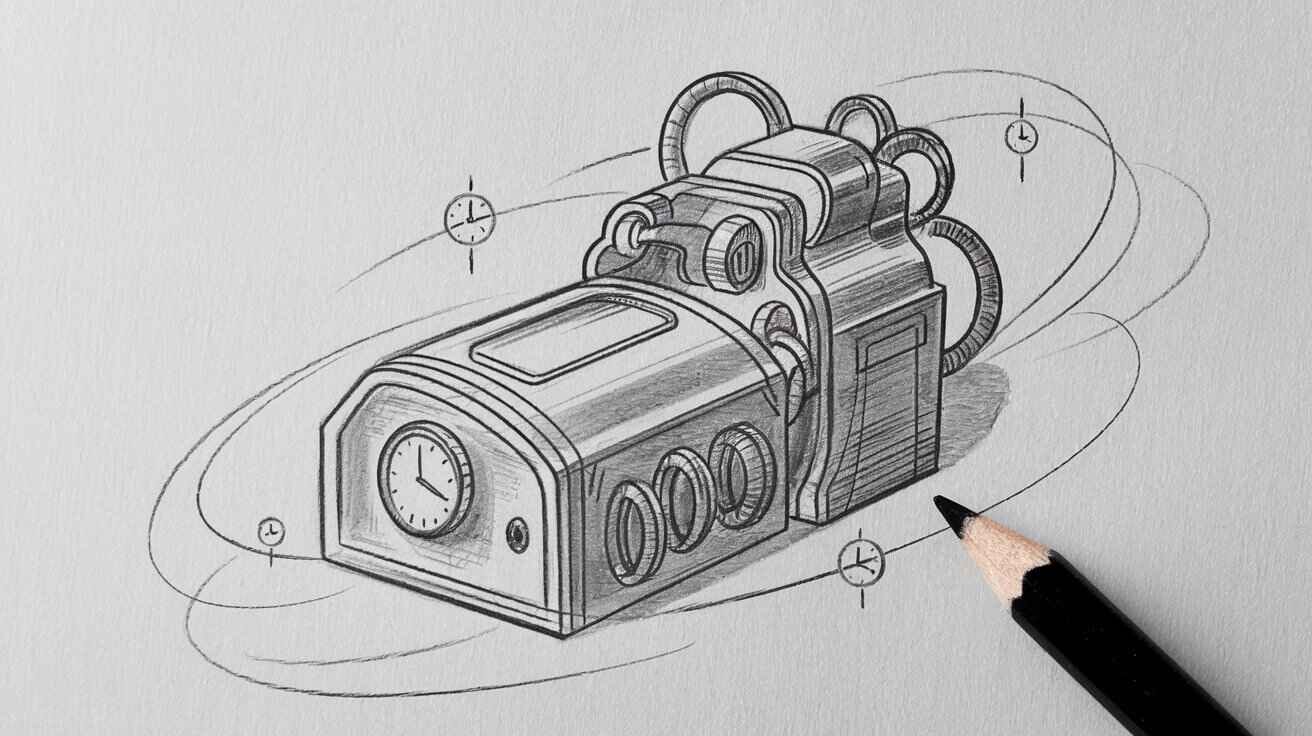
Time travel involves the movement of people and objects through the ‘time-space continuum’ into the past and the future. Travelling through time is known as time travel and is famous in modern philosophies and literature, especially science fiction. In fiction, time travel is always realized with the help of an imaginary gadget called a time machine. The concept of time machines is unknown to most people. It was first introduced as a novel in 1895 by H. G. Wells and titled The Time Machine.
The Science of Time
From the modern physical perspective, time is not even a concrete, independent backdrop variable but rather the fourth dimension of spacetime. This idea has been brought forward with the help of theoretical physics, where Einstein’s theory of relativity indicates that time is not the constant it was thought to be but rather varies with the position and movement of a particular observer. Still, it needs to be determined whether time travel to the past is constructively feasible. If at all conducted, such travel may create controversies over causation. Time ahead, beyond the feelings and perception of time, is a very common phenomenon and is thoroughly explained in special relativity as well as in general relativity. However, it is impossible in the current state of technology to cause the advance or delay of one body by more than a few milliseconds relative to another body. Regarding travel back in time, there are solutions possible within general relativity, for example, a rotating black hole. Relativistic travel to an arbitrary point in spacetime has a fragile theoretical basis and is generally linked to quantum mechanics, or rather, to wormholes.
Is Time Travel Possible in 2050? What Physics Says
By 2050, forward time travel via time dilation will still be the only form humanity can actually use and only in tiny amounts. Relativistic effects only become dramatic near the speed of light or next to extremely strong gravity (like a black hole's edge), and no spacecraft on any credible 2050 roadmap gets close to either.
Backward time travel is a different story. Physicists studying Einstein's field equations have found mathematical solutions, such as the Gödel metric, the Tipler cylinder, and traversable wormhole geometries, that technically permit closed timelike curves (CTCs), paths through spacetime that loop back on themselves. A well-known arXiv research paper cataloguing these solutions confirms this class of solutions is fully consistent with general relativity, not a computational error or a fringe idea.
The catch is enormous: every known CTC solution requires conditions we have no way to produce, infinitely long spinning cylinders of extreme density, exotic matter with negative energy density, or a rotating universe (ours doesn't appear to rotate). Physicist Stephen Hawking proposed the chronology protection conjecture, arguing that some deeper, still-undiscovered law of physics likely prevents these loops from forming at any scale we could use. So by 2050, the honest answer is: mathematically allowed, physically inaccessible.
Will Time Travel Be Possible in the Near or Distant Future? (2025 to 2080 and Beyond)
Let's break it down by era. Here's what's realistic, decade by decade.
- 2025–2040: We can already measure forward time dilation. But it's tiny. We're talking nanoseconds to microseconds. That's true for satellites and astronauts alike. Backward time travel? Not close. No tech exists for that.
- 2040–2060: Spacecraft may get faster. Missions may get longer. Maybe we'll reach Mars and beyond. That could push time dilation into the millisecond range. Still, this is all forward-only.
- 2060–2080: Picture a spacecraft that can hit a real fraction of light speed. That's a big "if". But if we build one, forward time dilation gets serious. Years could pass on Earth. The crew might age only months. Backward time travel is a different story. It would still need exotic matter. Or strange spacetime shapes we can't build yet.
- Beyond 2080: Backward time travel depends on things we can't predict today. We'd need new physics. Something beyond general relativity and quantum mechanics. We'd also need to know if Hawking was right about chronology protection.
Is It Possible to Time Travel to the Past?
This is the hard part. Most physicists doubt it will ever really work. The math doesn't rule it out. But three big walls stand in the way.
Exotic matter. A wormhole needs to stay open. That takes matter with negative energy. We've only seen tiny hints of this, like the Casimir effect. It's nowhere near enough.
Paradoxes. You've heard of the grandfather paradox. Go back in time. Stop your own birth. It's a real logical snag. Some theories dodge it. They use self-consistency rules. Or many parallel worlds. Neither idea has been proven.
Chronology protection. Stephen Hawking had a theory here. He thought nature blocks time loops on purpose. Even if the math allows them.
Physicist Sean Carroll from Caltech breaks this down well. Read more in Scientific American's feature on time travelers and wormholes.
| Continue discovering more: AI in Healthcare Examples. |
|---|
Different spacetime geometries
Not every time-travel idea looks the same. Physicists have found several spacetime shapes that allow closed timelike curves, at least on paper.
In the general theory of relativity, the geometric picture of the universe is given by the system of equations and field equations that define the metric or distance of spacetime. These equations do possess certain solutions, and these concern what is referred to as closed time-like curves; these are world lines that are capable of intersecting one another. In other words, some point on a given world line may be in the causal future of that line and also in the causal past; that is time travel. A solution that conforms to these intuitions was first offered by an Austrian mathematician, Kurt Gödel, and is called the Gödel metric, yet it is a drawback that his (and others') solution assumes the universe to possess features it does not seem to possess, namely rotation and no Hubble expansion. Whether general relativity barred closed time-like curves in all realistic circumstances still has to be understood.
Gödel metric
A whole universe that spins. Time loops exist everywhere in it.
Van Stockum cylinder
An endless, dense, spinning cylinder. It drags spacetime into a loop.
Tipler cylinder
A shorter, denser spinning cylinder. Closer to "buildable." Still impossible with matter we know.
Kerr black hole
A spinning black hole. Time loops may hide inside it.
Traversable wormhole
Two wormhole mouths. Give them different histories. A time gap opens up.
Wormholes: Shortcuts Through Spacetime?
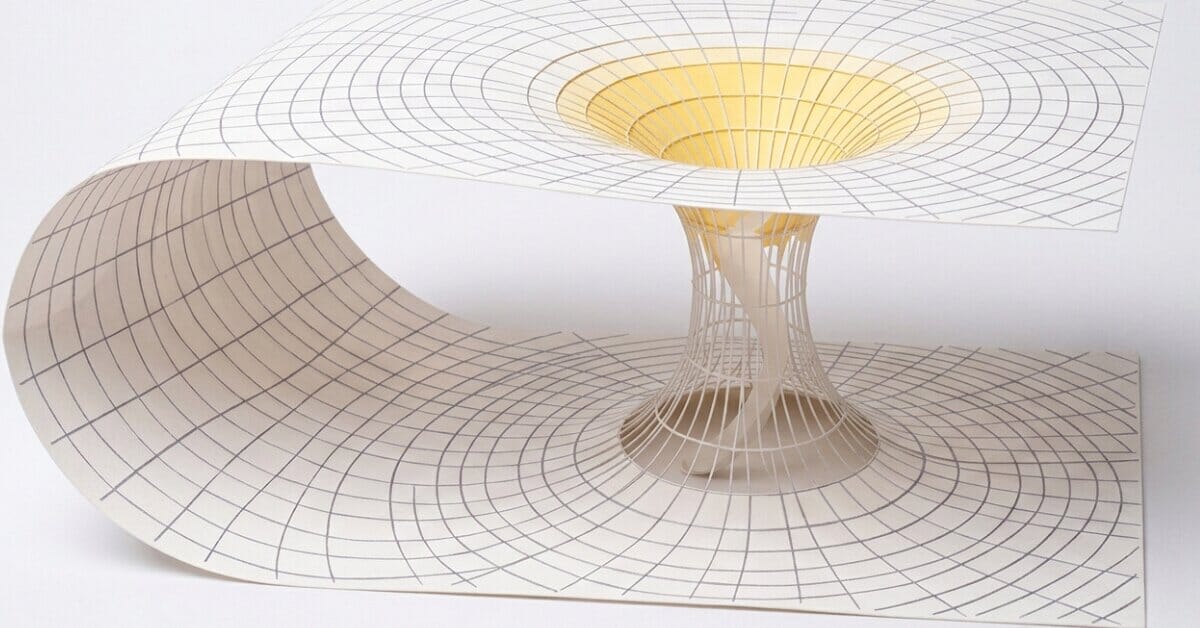
The second theoretical possibility of time travel is in wormholes What is a wormhole? About these hypothetical tunnels, some points in spacetime could be connected,d and one could potentially travel from one location to another almost instantly. At the same time, wormholes exist only on paper, and to maintain one for travel, you would need to use materials that hardly exist in real life.
Kip Thorne and his team studied this in the late 1980s. Here's the idea. Take one end of the wormhole. Speed it up close to light speed. Bring it back. Now the two ends are out of sync in time. It works a lot like the classic twin paradox.
But there's a catch. The wormhole has to stay open. That needs "exotic matter." This matter would have to break a basic rule of physics called the weak energy condition. So far, nothing we've found can do that at any real scale.
Scientists are still exploring this. In 2026, researchers looked at ring-shaped wormholes. Under the right conditions, these might form time loops too. It's still just theory, and the researchers say so themselves. Want to go deeper on the basics? Read our guide to black holes, event horizons, and Hawking radiation.
Time Travel Awareness and the Media
Though one cannot physically go back to the time of the dinosaurs in a car like in the famous movie ‘Back to the Future,’ the theory of time travel is an important area of study in cosmology. It puts one into the position where the subject becomes the question, where reality, the very conception of time, space, and causality are put into question. Who knows how many opportunities the further development of science will open in the future to us? So maybe one day, instead of talking about the possibilities of time travel,l people would be able to physically travel through time.
Just because time travel is not a reality in twenty-first-century society, the desire to explore and discover the universe's outer limits is still real.
FAQ
Is time travel real?
Yes, in one sense. Forward time travel is real. We can measure it. Clocks on GPS satellites run a little differently than clocks on Earth. So do clocks on the space station. That's time dilation, and it's proven. Backward time travel is a different story. No evidence backs it up. It's still just theory.
Has time travel been achieved?
Not the way movies show it. No one has jumped forward or backward in time in any big way. Astronauts have picked up tiny amounts of forward time dilation from spaceflight. But that's microseconds, not years. No one has ever traveled to the past.
Does time travel exist?
Time dilation does exist. It's real, and we use it every day through GPS. But traveling to the past, or jumping decades ahead on purpose, doesn't exist yet. It may never be possible in a way we could actually use.
Is it possible to travel back in time?
The math says maybe. Certain spacetime shapes, like wormholes and spinning cylinders, could allow it in theory. But none of them can be built with anything we know how to make. Many physicists think a deeper law of nature blocks it anyway. That's Hawking's chronology protection idea.
Are time travelers real?
No solid evidence says yes. Stories about time travelers pop up online now and then. But they don't hold up. Physics doesn't back them.
Time machine 2006 calendar
ReplyDelete