
The Higgs boson takes its name from physicist Peter Higgs. Scientists first proposed it in the 1960s to explain how particles gain mass. Some media outlets called it the God particle. But scientists usually use the name Higgs boson. In 2012, researchers at CERN confirmed its existence through the ATLAS and CMS experiments.
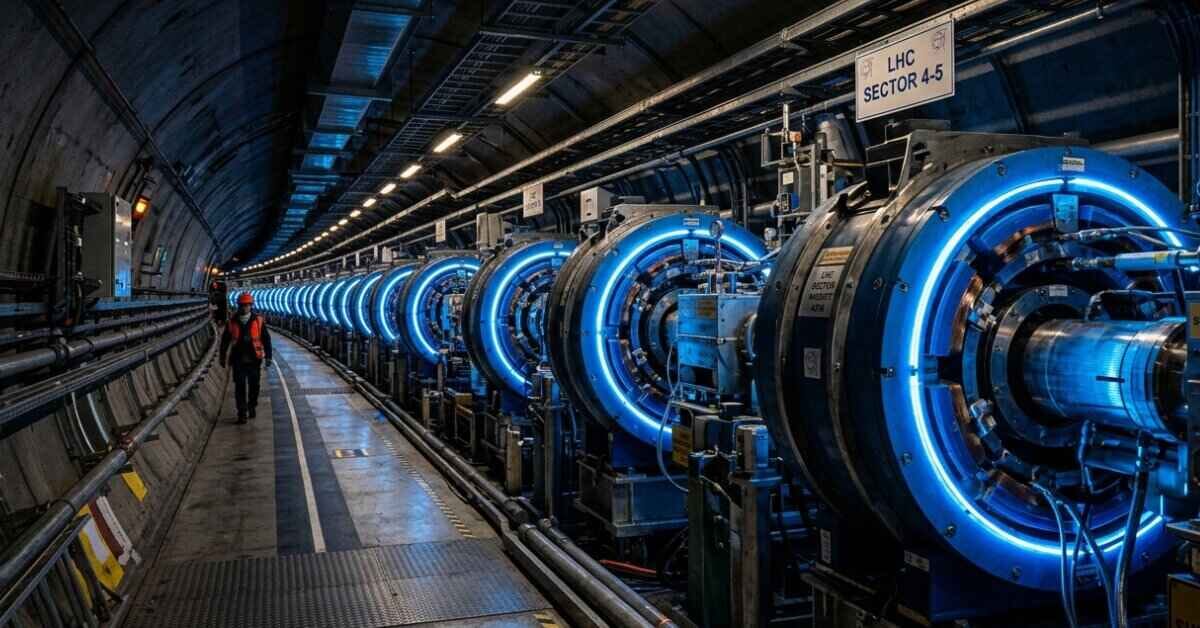
Table of Contents
What Is the God Particle?
There is a hidden field running through everything. Through you. Through stars. Through empty space. You can't see it. You can't touch it. But without it, nothing would exist the way it does. This field gives matter its mass. It slows particles down. It lets them stick together. Without it, electrons and quarks would fly around at the speed of light. They'd never meet. Never bond. Never build anything.
No atoms. No molecules. No planets. No people.
The solid world you stand on, your body, the chair, the ground, it all comes down to this invisible field doing its quiet, thankless job. It asks for nothing. It gets no credit. But it holds everything together.
The particle associated with that field has one of the most dramatic nicknames in all of science: the God particle. It is a name that has thrilled headline writers and horrified physicists in roughly equal measure.
Its proper name is the Higgs boson, and understanding what it really is, what it does, and why finding it mattered so much is one of the great stories of modern science.
Why Is It Called the God Particle?
The phrase God particle did not emerge from a physics lecture or a research paper. It came from a book.
Leon Lederman was a physicist who won the Nobel Prize. In 1993, he wrote a popular science book. He called it The God Particle.
But that wasn't his first choice of title. Lederman had spent many years trying to find a tiny particle called the Higgs boson. He never found it. It kept slipping through his grasp. This frustrated him deeply. So he wanted to call it "the Goddamn Particle."
His publisher said no. That word was too rude for a book title. They agreed on God Particle instead.
The name caught on quickly. It was short. It was bold. People couldn't stop using it.

Why Scientists Hate It
If you want to irritate a particle physicist, call it the God particle.
Peter Higgs is the Scottish physicist the particle is named after. He has said the nickname embarrasses him. He also thinks it sends the wrong message.
Most scientists agree with him. They are not comfortable with the name either.
The problem is what the name suggests. It makes the particle sound religious. It is not. It also makes the particle sound more important than everything else in the universe. But the universe is made up of many particles and forces. The Higgs boson is just one of them. It matters, but it is not the whole story.
The Higgs boson does not create everything. It does not hold the universe together. It is a crucial piece of a very large puzzle. But "Higgs boson" is the right name, and it is the one used in every scientific paper, textbook, and laboratory on the planet.
Is It the Same as the Higgs Boson?
Yes, completely. The God particle and the Higgs boson are the same thing. The God particle is simply a popular nickname; the Higgs boson is its scientific name.
With that cleared up, let's get to the fascinating physics of what the Higgs boson actually is and does.
What Does the Higgs Boson Do?
At its core, the Higgs boson's job, or more precisely, the job of the field it is associated with, is to give certain fundamental particles their mass.
Mass is such a basic property of matter that we rarely think to question why it exists. But in the framework of modern physics, mass is not a given. It requires an explanation. In the equations that describe fundamental particles, particles that interact with the electromagnetic force are naturally massless (photons, which are particles of light, are a perfect example). So how do particles like electrons and quarks acquire mass at all?
The answer is the Higgs mechanism.
The Crowd Analogy
Picture a big room packed with people, spread out evenly across the floor. Now imagine two different people walking in.
The first is nobody famous. People step aside. They barely notice. The person crosses the room quickly and easily.
The second is a celebrity. Immediately, people swarm around them. They grab at them, slow them down, pull them in every direction. The celebrity can barely move. All that attention creates a kind of drag.
The Higgs field works the same way. Think of it as the crowd. Particles move through it like people crossing the room.
Some particles interact with the field strongly. They get bogged down. That resistance is what we call mass. The top quark is one example. It interacts a lot, so it has a large mass.
Other particles interact only weakly. The electron is one. It picks up a little mass, but not much.
Some particles do not interact with the Higgs field at all. Photons are like this. Nothing slows them down. They stay massless and travel at the speed of light.
So what is the Higgs boson? It is what happens when you disturb the field. Give it a sharp jolt, and you get a tiny ripple. That ripple, caught for a brief moment under extreme conditions, is the Higgs boson.
The Higgs Field Explained
The Higgs field is invisible. You cannot see it, touch it, or measure it directly. But it fills every part of space. It is everywhere inside stars, in empty space, and everywhere in between.
In physics, every tiny particle comes from an underlying field. Think of a field as a kind of invisible fabric that fills all of space. A ripple in that fabric creates a particle. The Higgs boson is a ripple in the Higgs field.
Most fields are "switched off" when there are no particles around. The Higgs field is different. It is always "switched on." It has a constant value everywhere, even in empty space. When particles move through it, they interact with it. That interaction is what gives them mass.
So why was finding the Higgs boson such a big deal?
Scientists had long suspected the Higgs field was real. But suspecting something is not the same as proving it. The field itself cannot be seen or detected directly.
Finding the boson changed everything. It was the first solid proof that the field truly exists. Not just a useful idea. Not just a number in an equation. Something real woven into the very fabric of the universe.
Where Does the Higgs Boson Fit in the Standard Model?
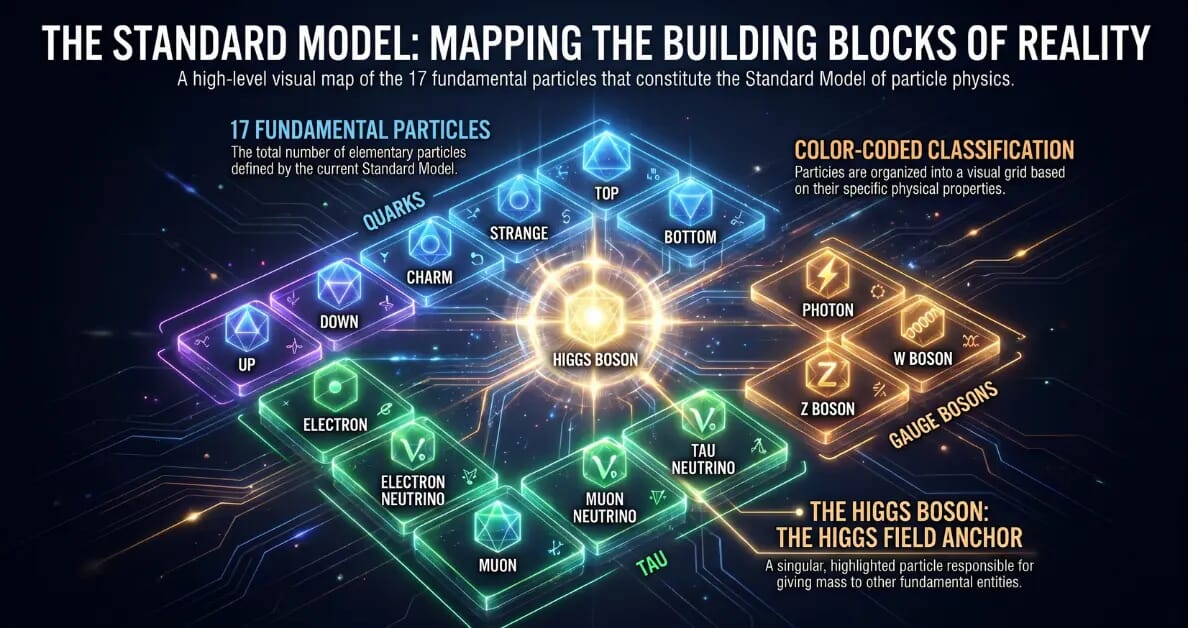
Scientists have a set of rules that explain what everything is made of. It is called the Standard Model. It describes the tiniest building blocks of matter — called particles. It also explains three of the four forces that control how things interact. These three forces are electromagnetism, the strong nuclear force, and the weak nuclear force. However, the Standard Model does not include gravity.
The Standard Model divides particles into two broad families:
- Fermions: the matter particles (quarks and leptons, including electrons and neutrinos)
- Bosons: the force-carrying particles (photons for electromagnetism, gluons for the strong force, W and Z bosons for the weak force)
The Higgs boson is a boson, but it is unique: it is the only fundamental scalar boson in the Standard Model, meaning it has no intrinsic spin. More importantly, it is the physical manifestation of the Higgs mechanism — the process by which the electroweak symmetry of the Standard Model is broken, allowing the W and Z bosons (but not the photon) to acquire mass.
Without the Higgs mechanism, the W and Z bosons would be massless, the weak nuclear force would behave very differently, and the nuclear processes that power the Sun and all stars would not work as they do.
The Higgs boson was the last particle predicted by the Standard Model to be experimentally confirmed. Its discovery in 2012 completed the Standard Model's particle roster after nearly five decades of searching.
How Was the God Particle Discovered?
The Day Scientists Found the God Particle
On July 4, 2012, history happened in a packed auditorium at CERN, the European Organization for Nuclear Research, near Geneva, Switzerland. Scientists and fans worldwide tuned in via live stream. Among those present sat Peter Higgs himself, then 83 years old.
Two independent teams — ATLAS and CMS — had been hunting the same prize at CERN's Large Hadron Collider. That morning, both stood up and delivered the same stunning verdict: they had discovered a new particle matching the long-predicted Higgs boson, carrying a mass of roughly 125 GeV.
The result cleared the 5 sigma threshold — the gold standard in particle physics, meaning a less-than-one-in-3.5-million chance of a false signal. The crowd erupted. Peter Higgs wiped a tear from his eye.
So what is the God Particle? It's the missing piece that explains how matter gets mass — and that day, physics finally had its proof. In 2013, Peter Higgs and François Englert shared the Nobel Prize in Physics for predicting its existence decades earlier.
What Happened After
Many people ask: What is the God particle? It is the popular nickname for the Higgs boson. Scientists discovered it in 2012. And since then, they have been studying it very carefully.
The results have been remarkable. Every test has pointed to the same answer. The particle behaves exactly the way scientists expected it to. It has the right mass. It spins the right way. It breaks apart into other particles in exactly the right pattern.
In short, it matches the Higgs boson predicted by science, almost perfectly.
But scientists are not simply taking that as a final answer. They keep running tests. They keep collecting data. They want to make sure nothing unexpected is hiding in the details.
So far, nothing unusual has shown up. The God particle appears to be exactly what the Standard Model said it would be. That is a huge confirmation for our understanding of how the universe works.
What Is the Large Hadron Collider?
The Large Hadron Collider is the biggest and most powerful machine of its kind in the world. Scientists call it the LHC for short. It was built and is run by an organisation called CERN.
The LHC is built inside a tunnel. The tunnel is circular and stretches 27 kilometres around. It sits about 100 metres underground, on the border between France and Switzerland.
Here is how it works. The LHC takes tiny particles called protons and accelerates them to nearly the speed of light. It sends two beams of protons racing in opposite directions around the ring. Then it smashes them together. Those collisions release an enormous burst of energy. That energy can produce new particles, including ones that have not existed since the very early universe.
To find the Higgs boson, scientists needed to recreate those extreme conditions. No machine before the LHC was powerful enough to do that. The LHC was built specifically for this purpose. It started running in 2008. It produces hundreds of millions of collisions every second, giving scientists enough data to spot rare particles hiding in the results.
The project was not small. It cost around €7.5 billion. It brought together thousands of scientists and engineers. They came from more than 100 countries around the world.
Who Predicted the Higgs Boson?
The theoretical prediction of the Higgs boson dates to 1964, when several physicists independently published papers proposing the mechanism by which particles could acquire mass through interaction with a background field.
The key contributors include:
- Peter Higgs (University of Edinburgh) predicted not only the field but specifically that its excitation would produce a detectable massive particle, which is why the boson bears his name.
- François Englert and Robert Brout (Université Libre de Bruxelles) published a related paper slightly earlier in 1964.
- Gerald Guralnik, C. R. Hagen, and Tom Kibble published a third independent paper later the same year.
The broader theoretical context was developed through the work of Sheldon Glashow, Abdus Salam, and Steven Weinberg, who built the electroweak theory in the 1960s and 1970s that the Higgs mechanism underpins — work for which they shared the 1979 Nobel Prize in Physics.
Englert and Higgs shared the 2013 Nobel Prize in Physics "for the theoretical discovery of a mechanism that contributes to our understanding of the origin of mass of subatomic particles." Brout, who might have shared it, had died in 2011, and the Nobel Prize is not awarded posthumously.
Why Does the God Particle Matter?
The most immediate significance of the Higgs boson discovery was scientific completion. The Standard Model had predicted the particle's existence for nearly 50 years. Without experimental confirmation, it remained an elegant but unverified theory. The 2012 discovery was the capstone — confirmation that the model's account of how particles acquire mass is fundamentally correct.
Implications for Physics
Beyond completing the roster, the Higgs boson offers a window into some of the deepest unsolved questions in physics:
The hierarchy problem. The Higgs boson's mass of ~125 GeV is theoretically puzzling. Quantum corrections should push its mass up to the Planck scale (roughly 10¹⁹ GeV) unless something cancels them out with extraordinary precision. Understanding why the Higgs mass is so "small" is one of the central open problems in theoretical physics — and a key motivation for theories such as supersymmetry.
The stability of the universe. Calculations based on the measured Higgs mass suggest that the universe may be in a state of "metastable" equilibrium — not the lowest possible energy state, but stable enough that it hasn't collapsed yet. If true, the universe could theoretically tunnel into a lower-energy state, with consequences that would propagate at the speed of light and be undetectable until they arrived.
Dark matter. The Higgs boson could potentially interact with dark matter particles — hypothetical particles that make up roughly 27% of the universe's mass-energy but have never been directly detected. Physicists are searching for possible Higgs decays that could provide clues.
Beyond the Standard Model. The Standard Model is known to be incomplete — it doesn't incorporate gravity, doesn't explain dark matter or dark energy, and doesn't account for the matter-antimatter asymmetry of the universe. The Higgs boson, as the newest and least-understood particle in the model, may be the most promising place to look for cracks that point toward new physics.
Common Questions About the God Particle
Q1: Is the God particle actually related to God?
No — it's just an informal nickname for the Higgs boson, coined for dramatic effect, with no religious or metaphysical meaning.
Q2: Can the Higgs boson destroy the universe?
Theoretically, the Higgs field could shift to a lower-energy state, but any such event would unfold over timescales vastly longer than the universe's current age, so no practical concern.
Q3: Why did it take so long to find the Higgs boson?
It's incredibly rare and vanishes almost instantly, so scientists needed billions of high-energy collisions and years of painstaking analysis to spot its decay signatures.
Q4: Is the Standard Model now complete?
Not quite — while all its predicted particles have been found, the model still can't account for gravity, dark matter, dark energy, or why matter dominates over antimatter.