
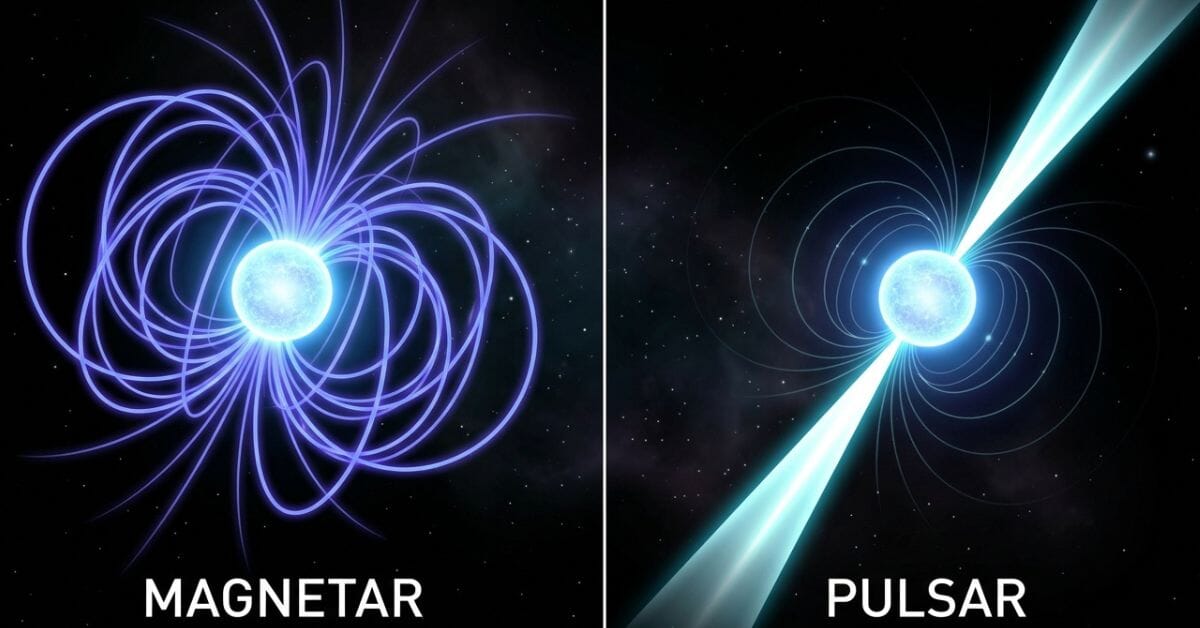
A magnetar is a neutron star defined by an extremely powerful magnetic field, up to 1,000 times stronger than a pulsar's. A pulsar is a neutron star defined by fast, regular rotation that produces sweeping radiation beams. Both form from the same kind of supernova, but a magnetar's identity comes from magnetism, while a pulsar's identity comes from precise spin.
If you've ever read about a neutron star, you've probably run into the terms "pulsar" and "magnetar" used almost interchangeably. They aren't the same thing. Both are extreme objects left behind when a massive star dies, but they behave in very different ways, and that difference matters if you want to understand how the universe's most powerful magnetic fields and radiation bursts actually work.
This guide breaks down what a magnetar is, what makes it different from a pulsar, and why scientists study both so closely.
Table of Contents
What Is a Magnetar?
A magnetar is a neutron star whose defining trait is an extraordinarily powerful magnetic field, often 10^14 to 10^15 gauss. For comparison, Earth's magnetic field is about 0.5 gauss. That field is strong enough to distort the structure of atoms near the star's surface, a scale of matter more commonly discussed in particle physics research like the search for the Higgs boson, and to stress the star's rigid crust until it cracks, releasing sudden flares of X-rays and gamma rays known as starquakes.
What Is a Pulsar?
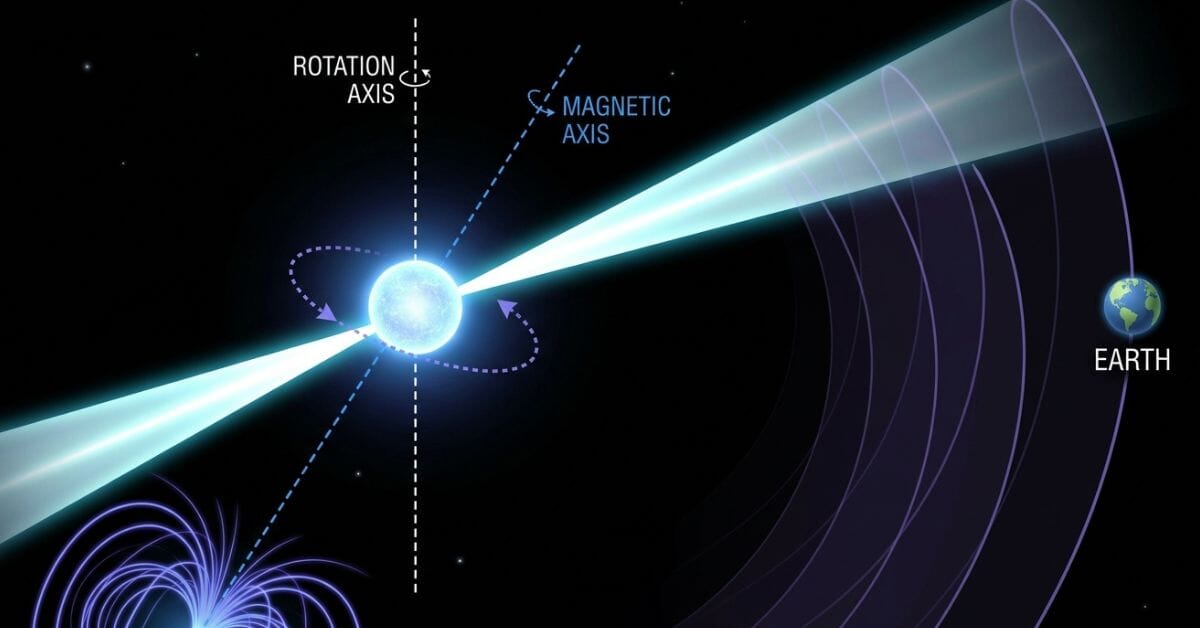
A pulsar is a neutron star whose defining trait is fast, regular rotation. As it spins, beams of radiation from its magnetic poles sweep through space. If a beam crosses Earth's line of sight, radio telescopes detect it as a regular pulse, similar to a lighthouse. Some pulsars rotate hundreds of times per second.
The Core Difference: Magnetism vs. Rotation
Both objects are neutron stars, so the real question isn't "what are they made of" but "what dominates their behavior." A pulsar's identity comes from its spin and the beam that spin produces. A magnetar's identity comes from its magnetic field, which is strong enough to shape its behavior even when rotation is comparatively slow, often once every few seconds rather than many times per second. Studying either object means working with physics far more extreme than anything achievable in a lab on Earth, in the same way researchers must use specialized techniques just to safely contain something as fragile as antimatter.
How Each One Forms
Both magnetars and pulsars form the same basic way: a massive star, roughly 10 to 25 times the Sun's mass, runs out of fuel, collapses, and explodes as a supernova. The leftover core becomes a neutron star about 20 kilometers wide but heavier than the Sun. Even more massive stars collapse further still, past the point where neutrons can hold the core up, forming a
black hole instead of a neutron star.
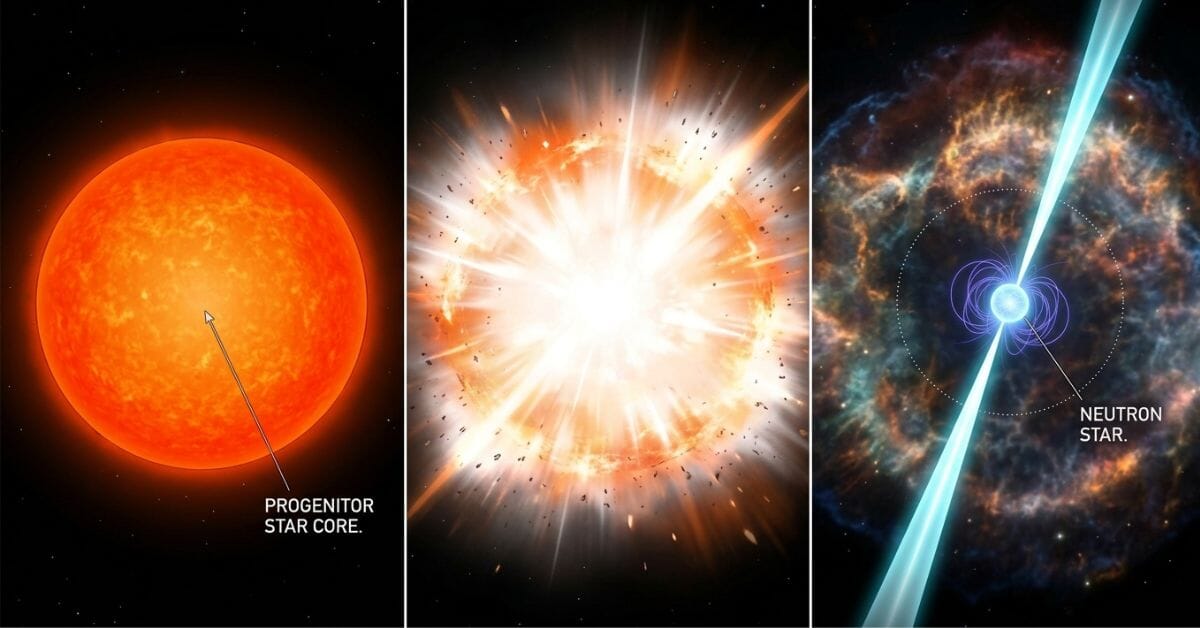
What likely separates the two outcomes is the newborn star's rotation and magnetic field at the moment of collapse. Some researchers think a very fast-spinning young core can act like a dynamo, amplifying the magnetic field to magnetar-level strength. A less extreme spin-up may instead leave behind a more typical pulsar.
How Scientists Detect Them
Pulsars are usually discovered through radio telescopes picking up their steady pulses. Magnetars are usually discovered through X-ray and gamma-ray telescopes catching an unexpected flare, as ESA explains. This difference in detection method is one reason magnetars were identified decades after pulsars: their bursts are irregular and easy to miss until an outburst happens during an active observation window.
Magnetar vs. Pulsar at a Glance
| Factor | Magnetar | Pulsar |
|---|---|---|
| Defining trait | Extreme magnetic field | Fast, regular rotation |
| Typical magnetic field | 1014–1015 gauss | ~1012 gauss |
| Typical detection | X-ray/gamma-ray telescopes | Radio telescopes |
| Emission pattern | Sudden, irregular bursts | Steady, periodic pulses |
| Known population | Fewer than 30 confirmed | Thousands confirmed |
| Best known for | Powerful flares, starquakes | Precision timing, gravitational wave research |
Why This Difference Matters
Pulsars work as extremely precise natural clocks. Astronomers use networks of pulsars, called pulsar timing arrays, to search for gravitational waves from slowly merging supermassive black holes and to test Einstein's general relativity. Magnetars, by contrast, help explain some of the most energetic short-lived events in the sky. Their giant flares are also considered a leading, though not fully confirmed, explanation for some fast radio bursts, the brief and intense radio signals detected from deep space.
Common Misconceptions
Magnetars and pulsars are different kinds of stars. They're both neutron stars; the labels describe dominant behavior, not different origins.
Magnetars don't spin. They do rotate, typically just slower than most known pulsars.
Every neutron star is either a magnetar or a pulsar. Many neutron stars show neither strong magnetism nor a beam pointed at Earth, so they go undetected by either method.
Frequently Asked Questions
Can a pulsar turn into a magnetar?
Some researchers suspect certain neutron stars may shift behavior over time as their magnetic fields evolve, but this isn't confirmed. It remains an open question in current astrophysics research.
Which is more dangerous, a magnetar or a pulsar?
A magnetar's flares release far more energy in a short burst. Both types are so far from Earth that neither poses a realistic danger under normal circumstances.
How many magnetars have been confirmed?
Fewer than 30 magnetars are confirmed, compared to thousands of known pulsars, making magnetars a much smaller, less-studied population, according to NASA. For the latest confirmed count, check a current source such as the ATNF Pulsar Catalogue.
Why do pulsars pulse instead of glowing steadily?
Their radiation beams come from the magnetic poles, which are usually tilted away from the rotation axis. As the star spins, the beam sweeps past Earth periodically, like a lighthouse, rather than shining toward us constantly.
What is a starquake?
A starquake is a sudden crack or shift in a neutron star's rigid crust, caused by extreme internal magnetic stress. In magnetars, starquakes are what release the bursts of X-rays and gamma rays that make them detectable.
Magnetars and pulsars are two faces of the same kind of object: a collapsed stellar core just tens of kilometers wide. What sets them apart is which property dominates, an overwhelming magnetic field or a fast, precise spin. Knowing this one distinction makes it much easier to understand any headline, telescope discovery, or research paper involving these extreme stellar remnants. For the most current confirmed counts and discoveries, check an up-to-date source such as NASA's overview of neutron stars or the ATNF Pulsar Catalogue.