
Antimatter sounds like something out of science fiction. It powers starships in movies and gets blamed for fictional explosions. But antimatter is real, and physicists study it every day. So what is antimatter, exactly, and why does it matter literally?
This guide explains antimatter in plain language, covering its discovery, its properties, and the real science behind what happens when it meets ordinary matter.
Table of Contents
What Is Antimatter?
Antimatter is a form of matter made of particles that are almost identical to ordinary particles, but with the opposite electric charge. Every particle in the universe, like the electron or proton, has an antimatter twin. When a particle meets its antimatter twin, both are destroyed and converted into pure energy. Antimatter is real, has been created in labs, and exists in tiny amounts throughout the universe.
That short answer covers the basics. The rest of this article explains how antimatter works, where it comes from, why it is so rare, and what scientists are still trying to figure out about it.
How Antimatter Works: Particles and Their Opposites
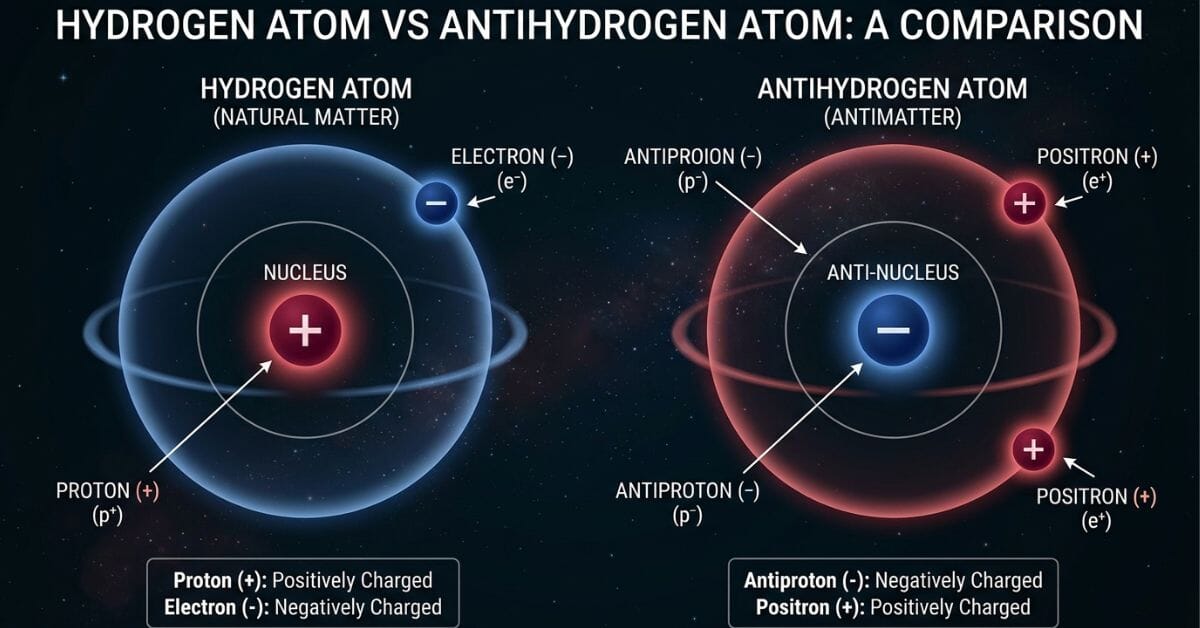
Every particle of ordinary matter has a matching antimatter particle, called an antiparticle. An antiparticle has the same mass as its matter counterpart, but its electric charge is flipped.
Take the electron, a negatively charged particle found in every atom. Its antimatter twin is the positron. A positron has the exact same mass as an electron, but it carries a positive charge instead of a negative one.
The same idea applies across particle physics:
The proton's antiparticle is the antiproton, which has a negative charge instead of a positive one.
The neutron, which has no charge, still has an antimatter version called the antineutron. It differs in a property called quantum spin and in how its internal quarks are arranged.
Even quarks, the tiny particles that make up protons and neutrons, have antiquark partners.
When antiparticles combine, they can form antimatter atoms. The simplest example is antihydrogen, made from one antiproton and one positron. Antihydrogen behaves like a mirror image of ordinary hydrogen, at least according to every experiment run so far.
This idea comes from theoretical physics. In 1928, physicist Paul Dirac combined quantum mechanics with Einstein's special relativity to describe the electron. His equation predicted a second particle with the same mass but opposite charge. At the time, this seemed like a strange mathematical side effect. Four years later, physicist Carl Anderson found that particle in cosmic ray experiments and named it the positron. It was the first confirmed antiparticle, and it proved that antimatter was more than an equation.
Where Does Antimatter Come From?
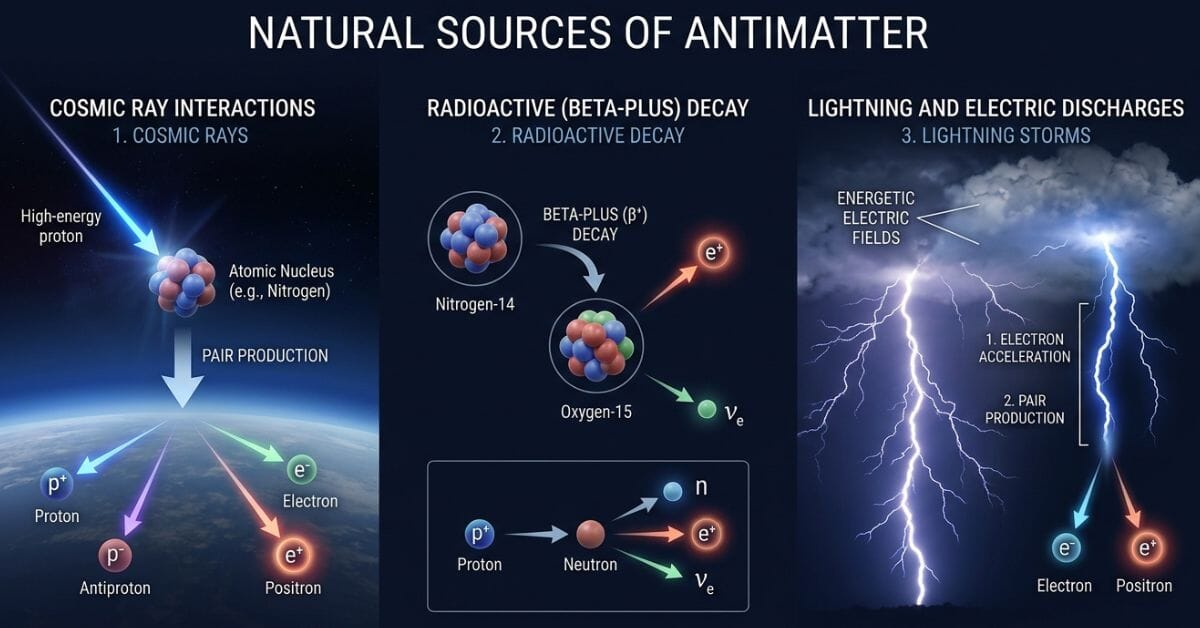
Antimatter is not something scientists invented. It forms naturally through several processes, though only in extremely small quantities.
Cosmic rays and space. High-energy particles from space, called cosmic rays, constantly strike Earth's upper atmosphere. These collisions produce small numbers of antiparticles, including positrons and antiprotons. Space-based detectors, like the Alpha Magnetic Spectrometer mounted on the International Space Station, regularly detect these particles.
Radioactive decay. Some radioactive elements naturally release positrons as they decay. Potassium-40, a radioactive isotope found in bananas and the human body, occasionally decays this way. This means every person carries out a tiny amount of natural antimatter production inside their own body, though the amounts are far too small to matter for health.
Lightning storms. Research has shown that powerful lightning storms and thunderclouds can briefly generate gamma rays energetic enough to produce positron-electron pairs in Earth's atmosphere.
Particle accelerators. The most controlled and reliable source of antimatter is a particle accelerator. Facilities like CERN, the European laboratory for particle physics, routinely produce antiprotons and use them to build antihydrogen atoms for study.
In every case, the antimatter produced is a minuscule amount compared to the ordinary matter around us. Nature does not appear to favor making antimatter, which turns out to be one of physics' biggest open questions, covered later in this article.
How Scientists Make and Study Antimatter
Making antimatter in a lab is a demanding process that requires enormous amounts of energy and extremely precise equipment.
At CERN's Antimatter Factory, researchers first create antiprotons by firing protons at high speed into a metal target. This collision releases a spray of particles, some of which are antiprotons. These are slow, difficult to isolate, and easily destroyed if they touch ordinary matter.
The antiprotons are then decelerated and cooled using a device called the Antiproton Decelerator, which slows them down enough to be trapped and studied. To build antihydrogen, scientists combine these antiprotons with positrons, which typically come from a radioactive source, inside a special magnetic trap. This trap holds the resulting antihydrogen atoms in place using magnetic fields, since the antimatter would be destroyed instantly if it touched the walls of a normal container.
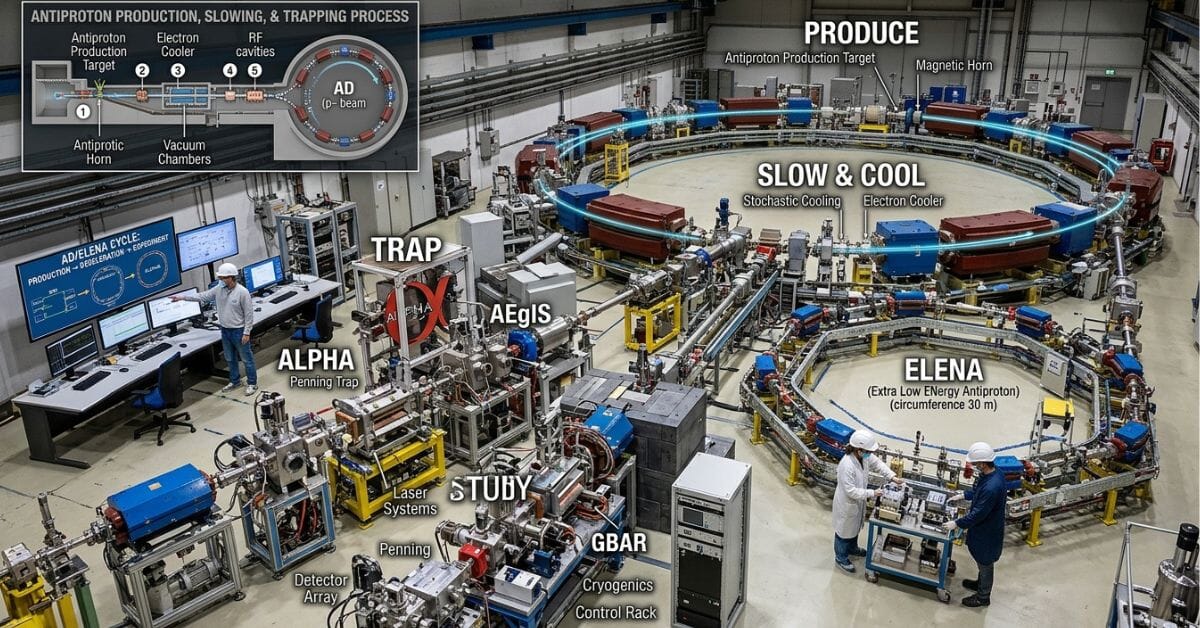
This is genuinely difficult work. For years, producing enough antihydrogen atoms to study required weeks of effort. In November 2025, researchers at CERN's ALPHA experiment reported a new cooling technique, adding a cloud of laser-cooled beryllium ions to chill the positrons before mixing, that let them produce over 15,000 antihydrogen atoms in a matter of hours, work that previously took about ten weeks. That leap in production let the team run far more sensitive experiments.
Using this larger supply of antihydrogen, the ALPHA Collaboration reported in May 2026 a hundredfold improvement in measuring a property called the hyperfine splitting of antihydrogen, essentially a tiny energy gap inside the antimatter atom. The new measurement reached a precision of 4 parts per million, letting physicists compare hydrogen and antihydrogen more closely than ever before. So far, every precision test has found antihydrogen behaving exactly like ordinary hydrogen, which keeps a long-standing mystery about the universe very much open.
Antimatter vs. Matter: Key Differences
| Property | Matter | Antimatter |
|---|---|---|
| Electric charge | Standard (e.g., electron is negative) | Opposite (e.g., positron is positive) |
| Mass | Normal particle mass | Identical to its matter counterpart |
| Abundance in universe | Makes up nearly everything we observe | Extremely rare |
| Behavior on contact | Stable in normal conditions | Annihilates on contact with matter |
| Where it's found | Stars, planets, people, everyday objects | Cosmic rays, radioactive decay, particle accelerators |
| Gravity | Falls downward | Also falls downward, based on 2023 ALPHA-g results |
What Happens When Matter Meets Antimatter?
When a particle meets its antiparticle, they do not simply collide. They annihilate each other completely. Both particles disappear, and their combined mass converts into energy, following Einstein's famous equation, E = mc².
For example, when an electron meets a positron, the result is usually a burst of gamma-ray photons. This process is not destruction in a violent, explosive sense so much as a complete conversion of matter into energy. It happens on a subatomic scale, and the energy released depends entirely on how much antimatter is involved.
This is why antimatter cannot exist near ordinary matter for long. Even a tiny amount of antimatter reacts instantly with the surrounding air, walls, or containers, which is exactly why scientists rely on magnetic traps and vacuum chambers to keep it isolated.
For a deeper look at what antimatter's destructive potential does and doesn't mean in practice, see how dangerous antimatter really is and this breakdown of how much antimatter it would actually take to destroy Earth.
Why Is There So Little Antimatter in the Universe?
This is one of the biggest unsolved problems in physics.
According to the Standard Model, the leading theory that describes particle physics, the Big Bang should have created equal amounts of matter and antimatter. If that were true, matter and antimatter should have annihilated each other almost completely, leaving behind a universe filled mostly with energy and very little solid matter at all.
Instead, we live in a universe made almost entirely of matter. Stars, planets, and people are all built from matter, with only trace amounts of naturally occurring antimatter. Scientists call this imbalance baryon asymmetry, and no one has fully explained why it happened.
A few leading ideas try to account for it:
CP violation. Some particle interactions do not behave identically when their charge and spatial orientation are both flipped, a small asymmetry called CP violation. This has been observed in certain particle decays, but not at a scale large enough to explain the imbalance on its own.
Subtle differences between matter and antimatter. Experiments like ALPHA at CERN are testing whether antimatter obeys the same physical laws as matter with extreme precision, since even a tiny undiscovered difference could help explain why matter won out.
New, undiscovered physics. Many physicists suspect the explanation requires particles or interactions beyond the Standard Model that haven't been detected yet.
So far, every antimatter experiment, including the 2026 ALPHA hyperfine measurement described above, has shown antimatter obeying the same rules as matter. That consistency is scientifically valuable, but it also means the puzzle of cosmic matter-antimatter asymmetry remains unsolved.
What Is Antimatter Used For?
Antimatter is not just a laboratory curiosity. Positrons, the most accessible antimatter particle, are already used in real-world technology.
The clearest example is Positron Emission Tomography (PET scanning), a medical imaging technique used in hospitals worldwide. A patient is given a small amount of a radioactive tracer that emits positrons. When those positrons meet electrons in the body and annihilate, they release gamma rays that a scanner detects to build detailed images, commonly used to find cancer, study the brain, or examine heart function.
Beyond medicine, antimatter plays a role in fundamental physics research, helping scientists test the Standard Model and search for cracks in our understanding of the universe. Ideas like antimatter-powered spacecraft remain firmly theoretical for now, since producing and storing meaningful amounts of antimatter is extraordinarily expensive and difficult. For a closer look at where antimatter is genuinely useful today versus where it's still science fiction, see what antimatter is actually used for.
Is Antimatter Dangerous?
In theory, antimatter is the most energetic fuel imaginable, since a matter-antimatter reaction converts 100% of mass into energy. In practice, the antimatter humans have ever created amounts to a tiny fraction of a gram, nowhere near enough to pose a real-world hazard.
Producing and containing antimatter is so difficult and expensive that facilities like CERN generate only minuscule quantities for research, held safely inside magnetic traps under near-perfect vacuum. There is no scenario with current technology where lab-created antimatter could cause large-scale harm. For the full explanation of what would actually happen with larger amounts, and why science fiction scenarios don't match reality, read how dangerous antimatter really is.
Common Misconceptions About Antimatter
Misconception: Antimatter is a hypothetical or fictional substance. Antimatter is real and has been created and studied in laboratories since the 1930s. It appears throughout science fiction, but it is grounded in confirmed physics.
Misconception: Antimatter always explodes violently. Annihilation releases energy, but the effect depends entirely on the amount involved. The antimatter produced in labs today is far too small to cause any explosion.
Misconception: Antimatter is a different kind of energy. Antimatter is matter. It has mass and occupies space just like ordinary matter. It becomes energy only when it meets its matter counterpart and annihilates.
Misconception: Scientists can easily store large amounts of antimatter. Storing antimatter requires powerful magnetic traps and a near-perfect vacuum, and even then, only tiny quantities can be held for limited periods. Large-scale storage remains far beyond current technology.
Current Research and Open Questions
Antimatter research has advanced quickly in recent years. At CERN's Antimatter Factory, the ALPHA Collaboration has spent years trapping antihydrogen atoms and comparing their behavior to ordinary hydrogen with growing precision. In 2023, the related ALPHA-g experiment showed that antihydrogen falls downward under gravity, just like normal matter, addressing a long-standing question about whether antimatter might behave differently under gravity's pull.
More recently, a faster antihydrogen production technique reported in November 2025 let researchers accumulate more than 15,000 antihydrogen atoms in hours rather than weeks. Building on that progress, the ALPHA Collaboration announced in May 2026 that it had measured antihydrogen's hyperfine splitting, a subtle internal energy gap, with a hundredfold improvement in precision compared to earlier results. The measurement still shows antihydrogen matching ordinary hydrogen closely, but the improved precision means physicists can now search for tinier discrepancies than ever before.
These open questions remain active areas of research:
Does antimatter behave identically to matter under every physical law, or are there subtle differences still waiting to be found?
What mechanism explains why the universe ended up with far more matter than antimatter?
Can antimatter ever be produced and stored efficiently enough for practical applications beyond medicine?
Antimatter is not science fiction. It is a confirmed, well-studied part of physics, made of particles that mirror ordinary matter but carry the opposite charge. It forms naturally in tiny amounts through cosmic rays, radioactive decay, and lightning, and it can be produced deliberately in facilities like CERN's Antimatter Factory.
The central mystery is not whether antimatter exists, but why so little of it survived the early universe. Every high-precision experiment, including the latest antihydrogen measurements from CERN's ALPHA Collaboration, keeps confirming that antimatter follows the same physical laws as matter. That leaves scientists with one of physics' most persistent open questions: why does the universe run on matter at all? As detector technology and antimatter production techniques keep improving, researchers are getting closer to precise enough measurements to start finding answers.
Frequently Asked Questions
Is antimatter real, or is it just theoretical?
Antimatter is real. It was predicted mathematically in 1928 and confirmed experimentally in 1932 with the discovery of the positron. Scientists routinely produce and study it today.
What is the opposite of antimatter called?
The opposite of antimatter is ordinary matter, sometimes called baryonic matter, which makes up stars, planets, and everyday objects.
Can humans see antimatter?
Antimatter particles themselves are far too small to see, but scientists detect them indirectly using particle detectors that track the energy released when antimatter annihilates with matter.
How much antimatter has ever been created?
The total amount of antimatter ever produced by humans is far less than a single gram, and it exists only briefly before annihilating or needing to be stored in specialized traps.
Does antimatter exist naturally on Earth?
Yes, in tiny amounts. It forms from cosmic ray collisions in the atmosphere, certain types of radioactive decay, and even briefly during powerful lightning storms.
Why can't we use antimatter as a fuel source yet?
Producing antimatter currently costs far more energy than it would ever release, and storing it safely in large amounts is not yet technologically possible.
Is antimatter the same as dark matter?
No. Antimatter is a well-understood, confirmed form of matter that interacts with light and other matter. Dark matter is a separate, still-unexplained phenomenon that does not emit or interact with light in the way normal matter does.
The question this article can't fully answer
The Big Bang should have made equal amounts of matter and antimatter, and they should have destroyed each other. Yet we exist, made of the tiny leftover: about one extra particle for every billion pairs.
I checked this story against CERN, Nature and NASA sources and wrote it up as Antimatter: The Strange Opposite of Our Universe.
- How Dirac's equation predicted antimatter before anyone saw it
- What happens, with real numbers, when matter meets antimatter
- How CERN makes and traps antimatter, and how it was driven on a truck in March 2026
- Why the universe is made of matter, and the 2025 discovery that brought us closer
- 25 chapters with diagrams, worked examples, quizzes and a glossary
Every claim is labelled as established fact, theory, open question or fiction.