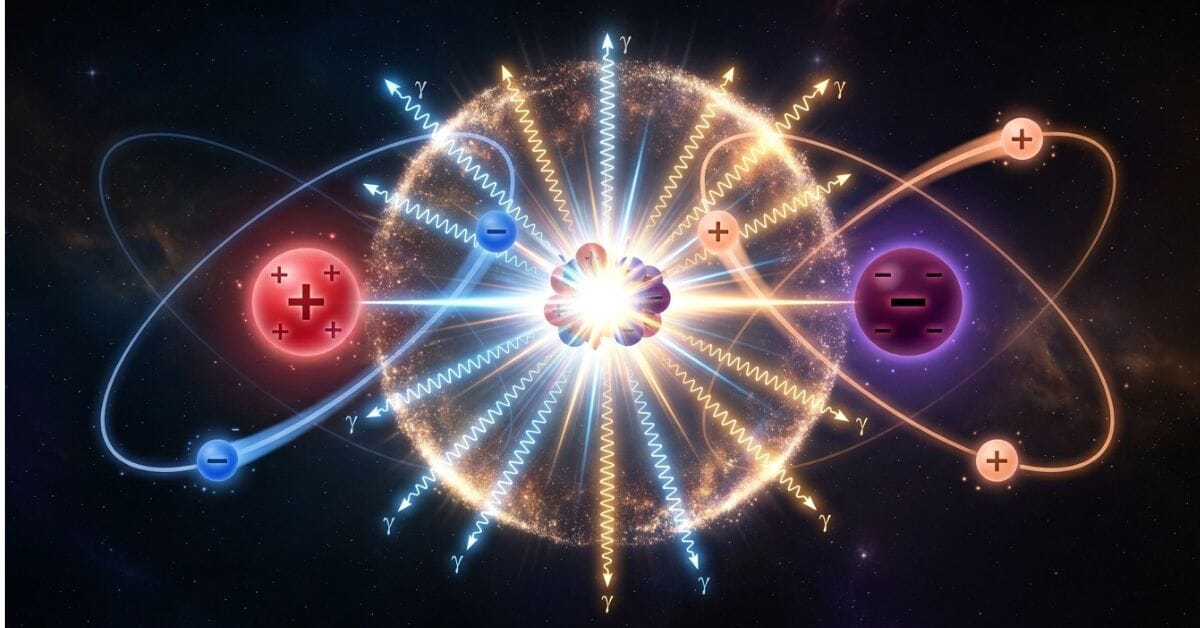
Yes, antimatter is real. It is not a theory or a science-fiction idea. Physicists have detected it, created it in laboratories, and measured its properties for over 90 years. Antimatter consists of particles that mirror ordinary matter but carry opposite electric charge. CERN, NASA, and other institutions produce and study it regularly, most recently transporting antiprotons by truck for the first time in 2026.
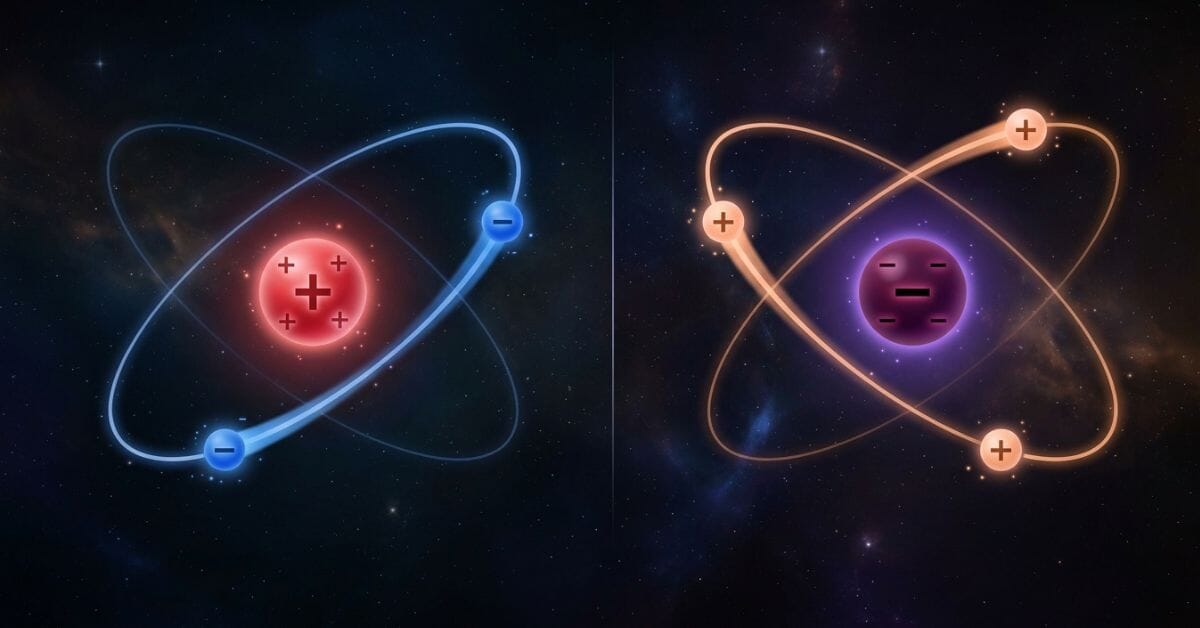
Table of Contents
Is Antimatter Real? A Simple, Direct Answer
Antimatter is real. It is one of the most well-tested ideas in modern physics, not a hypothetical concept. Scientists have observed antimatter particles in cosmic rays. It created them in particle accelerators and even trapped antihydrogen atoms long enough to study their behavior.
The confusion often comes from science fiction. Movies and books use antimatter as a fuel source or a weapon, which makes it sound like a fantasy. In reality, antimatter is a well-understood part of particle physics, and researchers work with it every day in laboratories around the world.
What Is Antimatter
Antimatter is made of antiparticles. An antiparticle has the same mass as its matter counterpart but the opposite electric charge.
For example:
An electron has a negative charge. Its antiparticle, the positron, has a positive charge but the same mass.
A proton has a positive charge. Its antiparticle, the antiproton, has a negative charge.
When a positron and an electron combine, they form antihydrogen, the antimatter version of a hydrogen atom. This is the most common form of antimatter that scientists build and study today.
Every known particle has a corresponding antiparticle. This pairing is a basic feature of particle physics, described by the Standard Model, the framework scientists use to explain particles and forces.
How Scientists Discovered Antimatter
Antimatter did not start as a guess. It came from mathematics.
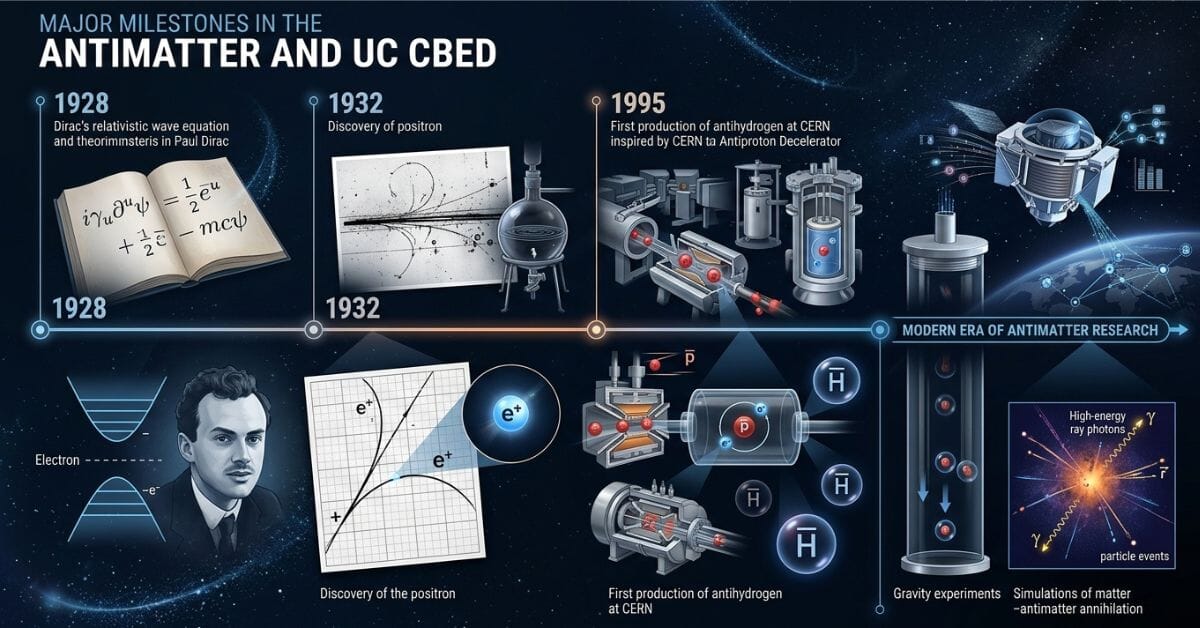
In 1928, physicist Paul Dirac was working on an equation to describe how electrons behave according to both quantum mechanics and special relativity. His equation produced a strange result: it allowed for a particle identical to the electron but with a positive charge. At first, this seemed like a mathematical error. Dirac soon proposed that it described a real, undiscovered particle.
Four years later, in 1932, physicist Carl Anderson confirmed the prediction. While studying cosmic rays with a cloud chamber, he photographed a particle that curved in the opposite direction from an electron in a magnetic field. He named it the positron. This was the first direct evidence of antimatter, and it earned Anderson the Nobel Prize in Physics.
Since then, scientists have confirmed antiparticles for protons, neutrons, and many other particles, cementing antimatter as an established, measurable part of nature.
Is Antimatter Real or Just a Theory?
This question comes up often because "antimatter" sounds abstract. But the evidence is concrete and repeatable:
Cosmic ray detections: Positrons and antiprotons are regularly detected in cosmic rays hitting Earth's atmosphere.
Laboratory creation: Facilities like CERN's Antiproton Decelerator produce antiprotons on demand.
Trapped antihydrogen: In 2010, the ALPHA experiment at CERN successfully trapped antihydrogen atoms, holding them in place long enough to study their properties directly.
Medical use: Positron Emission Tomography (PET scans) use positrons, a form of antimatter, in hospitals every day.
Physical transport: In March 2026, CERN's BASE experiment achieved a world first by physically transporting a container of about 100 antiprotons by truck across its campus near Geneva, keeping them stable in a supercooled magnetic trap. The antiprotons stayed encased in a transportable antiproton trap compact enough to fit through ordinary laboratory doors and load onto a truck, and the demonstration marked a significant technical milestone in experimental physics. PBSInnovation News Network
So the short answer to "is antimatter a real thing" is yes, and the evidence spans nearly a century of physics, from Nobel Prize-winning discoveries to a literal antimatter road trip in 2026.
How Is Antimatter Made Today?
Antimatter does not occur in large, stable amounts on Earth, so scientists have to make it. The main method uses particle accelerators.
Here is a simplified version of the process:
Accelerate protons to extremely high speeds using a particle accelerator.
Collide the protons into a solid target, such as a metal block.
The collision releases a burst of energy and particles, including some antiprotons.
Separate and slow down the antiprotons using magnetic fields, since they are initially moving too fast to study.
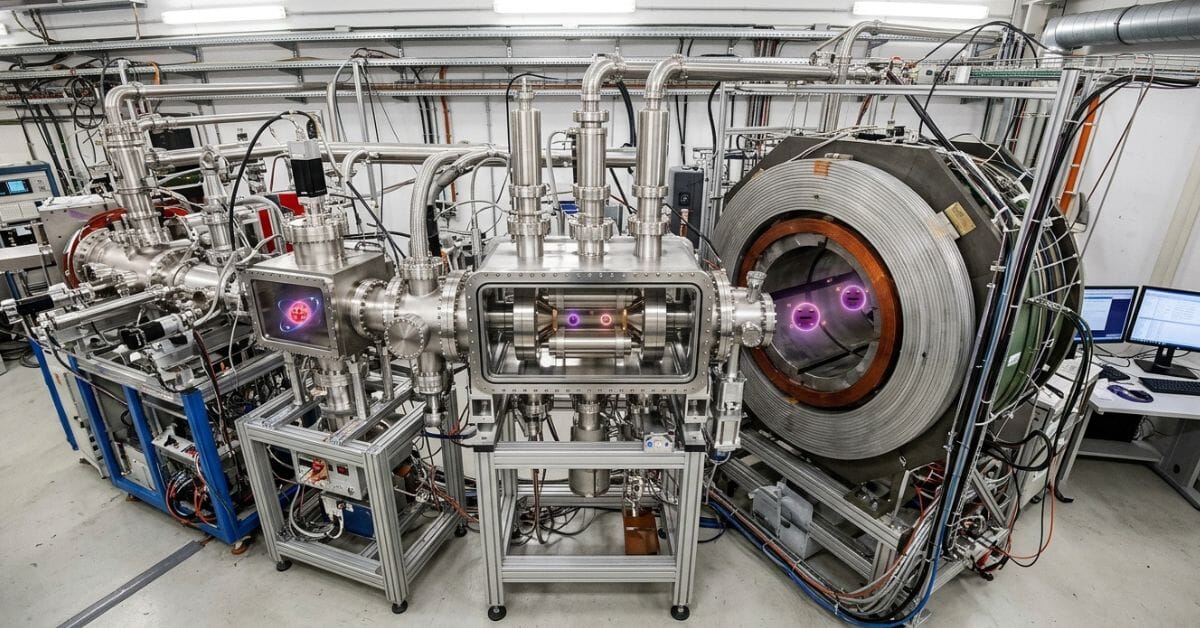
Trap and cool the antiprotons in a vacuum chamber using strong magnetic fields, keeping them away from any ordinary matter that would cause annihilation.
CERN's Antimatter Factory near Geneva is the world's leading center for this work. If you're curious about the mechanics of storing these particles safely, our guide on how antimatter is stored breaks down the trap technology in more detail.
Producing antimatter is extremely inefficient and expensive. Scientists estimate that making just one gram of antimatter would cost far more than any nation's yearly budget, which is one reason antimatter is often called the most expensive substance on Earth.
Where Is Antimatter Found in Nature?
Antimatter is not only made artificially. It also appears naturally, though in very small quantities.
Cosmic rays: High-energy particles from space regularly produce positrons and antiprotons when they collide with Earth's atmosphere.
Lightning storms: Some lightning events on Earth have been observed producing brief bursts of positrons.
Radioactive decay: Certain unstable atoms, like potassium-40, naturally release positrons as they decay. This even happens inside the human body in tiny amounts, since bananas and other foods contain trace potassium-40.
Black holes and neutron stars: Astronomers have observed evidence of antimatter production near some of the universe's most extreme objects.
None of these natural sources produce enough antimatter to collect or store in bulk. It appears briefly, interacts with nearby matter, and disappears almost immediately.
Why Is There So Little Antimatter in the Universe?
This is one of the biggest open questions in physics.
According to the Big Bang model, the early universe should have produced equal amounts of matter and antimatter. When matter and antimatter meet, they annihilate each other completely, converting into energy. If the universe truly started with equal parts of both, everything should have annihilated into pure energy, leaving no matter behind at all.
But that's not what happened. The universe today is made almost entirely of ordinary matter, with barely any leftover antimatter. Scientists call this imbalance baryon asymmetry, and it remains unsolved.
Some leading hypotheses include:
| Hypothesis | Basic Idea |
|---|---|
| CP violation | Matter and antimatter may not behave in perfectly identical, mirrored ways under certain conditions, creating a slight imbalance. |
| Unknown particles | An undiscovered particle or process from the early universe may have favored matter over antimatter. |
| Asymmetric initial conditions | The universe may have started with slightly more matter than antimatter for reasons not yet understood. |
Experiments like BASE and ALPHA at CERN test whether antimatter obeys the same physical laws as matter, including gravity and charge symmetry. Any measurable difference could help explain why matter won out. If you want deeper context on the dangers these unstable particles pose during experiments, see our article on how dangerous antimatter really is.
What Happens When Matter Meets Antimatter?
When a particle meets its antiparticle, they annihilate. Their combined mass converts entirely into energy, following Einstein's famous equation, E = mc².
This reaction is extremely efficient. A matter-antimatter annihilation releases far more energy, gram for gram, than nuclear fission or fusion. That's part of why antimatter shows up so often in science fiction as a power source or weapon.
In reality, current antimatter production is far too small and costly for anything like that. Physicists have calculated just how much antimatter would be needed to cause large-scale destruction, and the amount is nowhere close to what any lab can currently produce. You can read the full breakdown in our article on how much antimatter it would take to destroy Earth.
Common Misconceptions About Antimatter
Misconception: Antimatter is purely theoretical.
Antimatter has been detected, created, and measured since 1932. It's one of the most experimentally confirmed concepts in particle physics.
Misconception: Antimatter is always dangerous.
The antimatter scientists currently produce exists in tiny, carefully contained amounts. It poses no meaningful danger outside a controlled lab environment.
Misconception: Antimatter could power spacecraft soon.
While antimatter propulsion is scientifically possible in theory, current production methods are far too slow and expensive to fuel any spacecraft in the foreseeable future.
Misconception: Antimatter looks or behaves completely differently from matter.
Aside from opposite charge, antimatter particles behave almost identically to their matter counterparts under most conditions. Physicists are still testing whether subtle differences exist.
Why Antimatter Matters for Science
Studying antimatter helps physicists test the foundations of the universe itself. It plays a role in:
Testing fundamental symmetry: Comparing matter and antimatter helps confirm or challenge core physics laws.
Understanding the early universe: Antimatter research offers clues about the moments after the Big Bang.
Medical technology: PET scans, used to detect cancer and study brain activity, rely on positron-emitting antimatter reactions.
Everyday applications: Antimatter research has practical uses well beyond pure physics, as explored in our guide to what antimatter is used for.
For readers who want the full picture of what antimatter is at a basic level before diving deeper, our companion article, what is antimatter, is a useful starting point.
If this topic has you hooked, physicist Frank Close's book Antimatter (Oxford Landmark Science) is one of the most accessible deep dives into the subject. It walks through the discovery of antimatter and its role in modern physics in plain language, without requiring a science background.
 See Price on Amazon
So, is antimatter real? Yes, without question. From Paul Dirac's 1928 prediction to Carl Anderson's 1932 discovery, and now to CERN's 2026 antimatter road test, nearly a century of physics confirms that antimatter is a genuine, measurable part of our universe.
What remains uncertain isn't whether antimatter exists, but why the universe ended up with so little of it. That mystery keeps physicists at CERN, NASA, and universities around the world running new experiments, each one bringing us closer to understanding one of physics' deepest puzzles: why matter, and not antimatter, makes up almost everything we see today.