
A black hole is a region of space where gravity is so strong that nothing, not even light, can escape. Black holes form when massive stars collapse, and they range from small stellar-mass black holes to supermassive giants at the centers of galaxies. Scientists have confirmed they exist using gravitational waves, X-ray observations, and direct images from the Event Horizon Telescope.
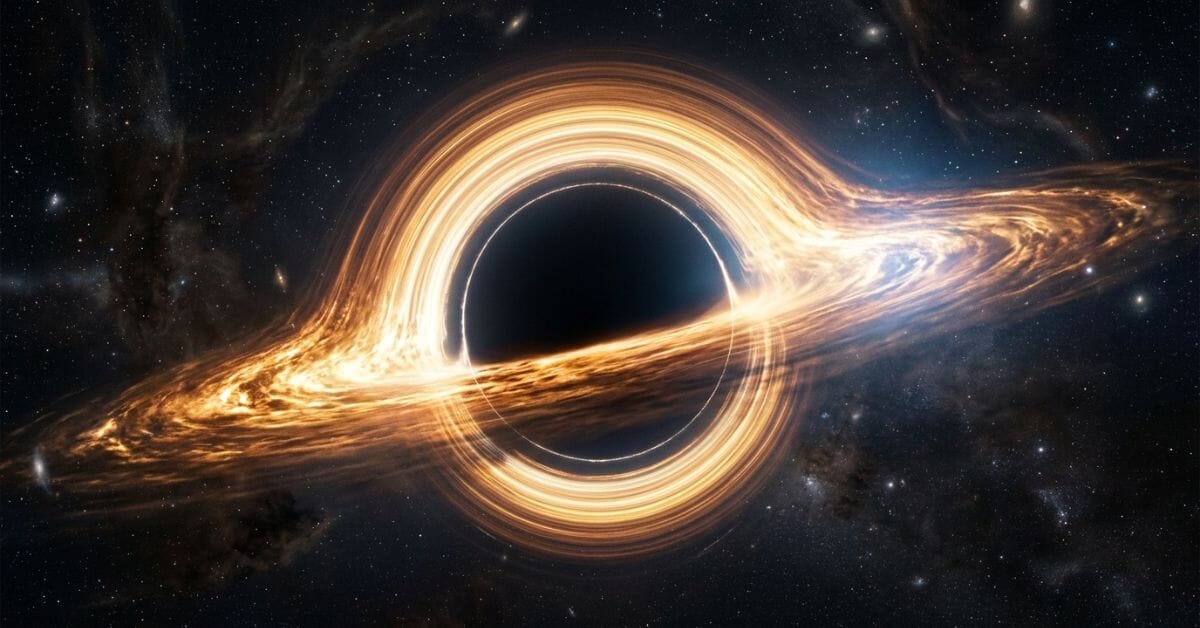
Table of Contents
What Is a Black Hole?
A black hole is a region of space where gravity pulls so strongly that nothing can escape, not even light. This happens when a huge amount of mass gets packed into a very small space.
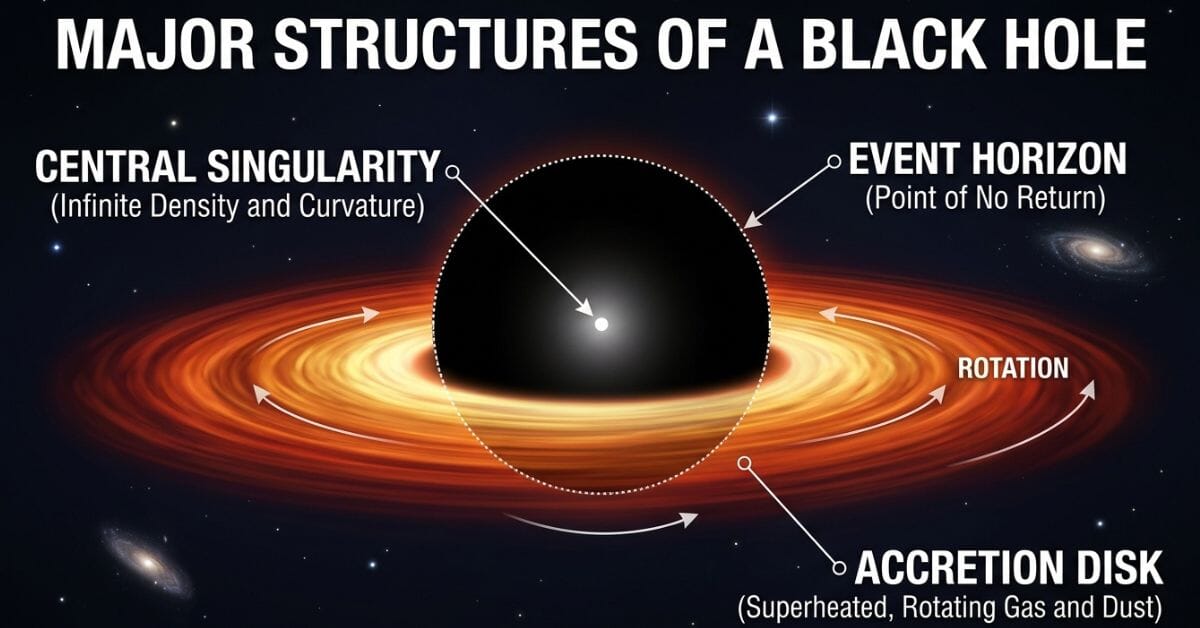
The edge of a black hole is called the event horizon. It is the point of no return. Once anything crosses the event horizon, it cannot come back out. Why are black holes black comes down to this simple fact: no light can escape to reach our eyes or telescopes.
Black holes are not empty holes in space. They are extremely dense objects. A black hole with the mass of the Sun would be squeezed into a sphere only a few kilometers across.
How Do Black Holes Form?
- Most black holes form when a massive star runs out of fuel. Here is the basic process:
- A star burns hydrogen and other elements for millions or billions of years.
- Once the fuel runs out, the star can no longer push back against its own gravity.
- The core collapses inward in seconds.
- If the core is massive enough, it collapses all the way into a black hole.
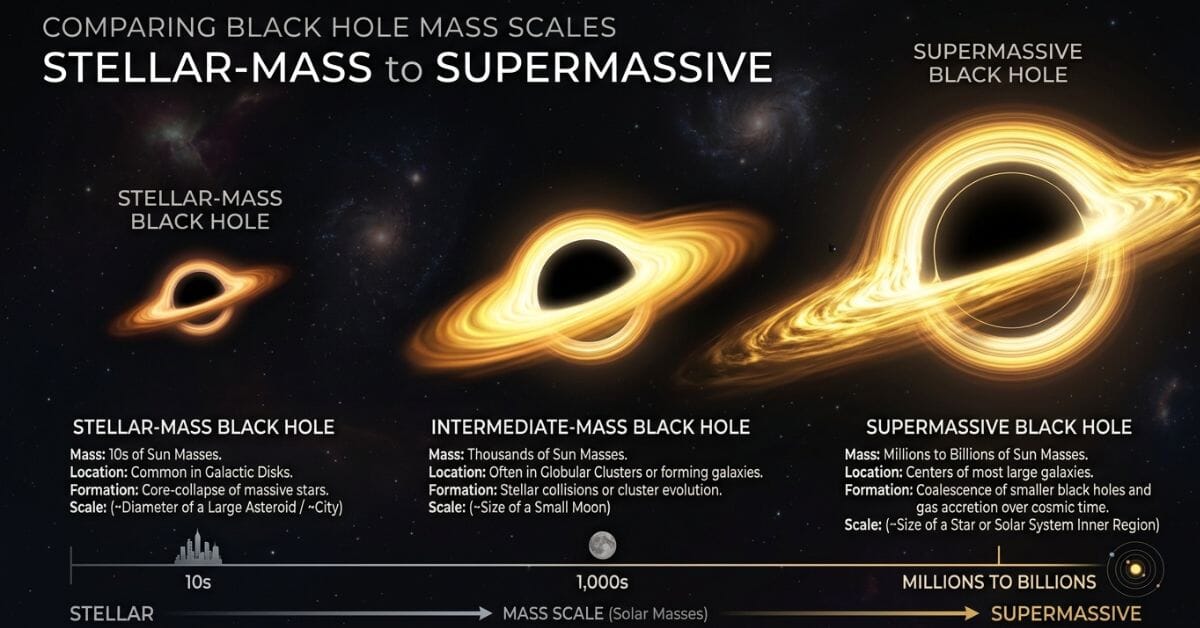
This is called a stellar-mass black hole. Other black holes, called supermassive black holes, are millions or billions of times heavier than the Sun. Scientists are still studying exactly how these giants grew so large. Leading ideas include the merging of smaller black holes over billions of years and rapid gas accretion in the early universe.
A third type, called intermediate-mass black holes, sits between these two groups. They are harder to find, but researchers have reported strong candidates in recent years.
Top 10 Facts About Black Holes
- Short on time? Here are the top 10 facts about black holes in one place.
- Black holes are regions where gravity is strong enough to trap light.
- The boundary of a black hole is called the event horizon.
- Most black holes form from the collapse of massive stars.
- Supermassive black holes sit at the center of most large galaxies.
- Our galaxy's supermassive black hole is called Sagittarius A*.
- The first-ever photo of a black hole was taken in 2019.
- Falling toward a black hole would stretch you like spaghetti.
- Time slows down near a black hole's event horizon.
- Black holes can collide and merge, creating gravitational waves.
- Black holes may slowly evaporate over trillions of years through Hawking radiation.
30 Interesting Facts About Black Holes
Basic Facts
- A black hole is not a hole at all. It is an extremely dense object with intense gravity, not an empty gap in space.
- Nothing can escape a black hole once it passes the event horizon. Not light, not radio waves, not spacecraft.
- Black holes have three basic properties: mass, spin, and electric charge. Almost everything else about their outside appearance is determined by these three numbers.
- The "point of no return" has a name. Scientists call it the event horizon, and its size grows with the black hole's mass.
- Black holes come in different sizes. The smallest known ones have a few times the mass of the Sun. The largest known ones have billions of times the Sun's mass.
Formation and Types
- Most stellar-mass black holes form when massive stars collapse at the end of their lives, often triggering a supernova explosion first.
- Supermassive black holes live at the centers of most large galaxies, including the Milky Way.
- Our galaxy's central black hole is called Sagittarius A*, and it holds about 4.3 million times the mass of the Sun.
- Intermediate-mass black holes are the rarest confirmed type. They sit between stellar-mass and supermassive black holes in size, and only a handful of strong candidates have been identified.
- Some black holes may be "primordial." This is a hypothesis suggesting a small number of black holes could have formed in the dense early universe rather than from dying stars. This idea has not been confirmed.
Extreme Physics Facts
- Gravity near a black hole is so strong that it bends light, an effect called gravitational lensing.
- Time slows down near a black hole. This effect, called time dilation, is a real, tested prediction of Einstein's general theory of relativity.
- Falling into a black hole would stretch an object into a long thin shape, an effect nicknamed "spaghettification," caused by the difference in gravitational pull on the near and far sides of the object.
- Black holes spin. Rotating black holes drag the space around them in a process called frame-dragging.
- A black hole's mass can be calculated by watching how nearby stars or gas move around it, without ever seeing the black hole itself.
- Black holes are not cosmic vacuum cleaners. They do not roam space "sucking up" everything nearby. Objects only fall in if their orbit brings them across the event horizon.
- The Sun will never become a black hole. It does not have enough mass. It will end its life as a white dwarf instead.
- If Earth were compressed into a black hole, it would be about the size of a marble, though this is a thought experiment, not something that could actually happen to Earth.
Discovery and Observation Facts
- Black holes cannot be seen directly, since they emit no light. Scientists find them by observing their effects on nearby matter, light, and space.
- The first-ever image of a black hole was released in April 2019 by the Event Horizon Telescope collaboration, showing the supermassive black hole at the center of galaxy M87.
- The Milky Way's black hole was imaged in 2022. This second image, of Sagittarius A*, confirmed the object at our galaxy's center is indeed a black hole.
- Gravitational waves from colliding black holes were detected for the first time in 2015 by the LIGO observatories, confirming a major prediction of Einstein's theory.
- Black holes can be detected through X-rays. Gas falling into a black hole heats up and glows in X-ray light before it disappears past the event horizon.
- Some of the earliest evidence for black holes came from X-ray binary systems, where a black hole pulls gas from a companion star.
Mind-Bending and Surprising Facts
- Black holes may eventually "evaporate." Physicist Stephen Hawking predicted that black holes slowly emit particles, called Hawking radiation, and lose mass over unimaginably long timescales.
- A supermassive black hole's average density can be lower than water, once you spread its mass across its enormous volume, even though the object itself is extreme.
- Two black holes can merge into one. When this happens, they release enormous amounts of energy as ripples in spacetime, called gravitational waves.
- Black holes challenge our understanding of physics. Inside them, general relativity (which describes gravity) and quantum mechanics (which describes particles) appear to conflict, and no accepted theory fully resolves this.
- Black holes are sometimes compared to wormholes in science fiction, but they are very different objects, and no evidence shows that black holes work as travel shortcuts. Learn more in this comparison of black holes vs. wormholes.
- Studying black holes helps scientists test extreme physics that cannot be recreated on Earth, similar to how researchers study other extreme phenomena, such as how dangerous antimatter really is, to understand the limits of known physics.
Types of Black Holes Compared
| Type | Typical Mass | How It Forms | Example |
|---|---|---|---|
| Stellar-mass | A few to tens of times the Sun's mass | Collapse of a massive star | Cygnus X-1 |
| Intermediate-mass | Hundreds to thousands of times the Sun's mass | Not fully confirmed; possibly mergers of smaller black holes | Rare candidates only |
| Supermassive | Millions to billions of times the Sun's mass | Not fully understood; likely growth over billions of years | Sagittarius A*, M87* |
Common Misconceptions About Black Holes
Misconception: Black holes suck in everything nearby. In reality, a black hole's gravity works the same way any object's gravity does. If the Sun were replaced by a black hole of the same mass, Earth's orbit would not change.
Misconception: You can see a black hole directly. Black holes emit no light. Scientists detect them by watching how they affect nearby stars, gas, and light, or by directly imaging the glowing material around them, as the Event Horizon Telescope did.
Misconception: Black holes are tunnels to other universes. This idea appears in science fiction and some theoretical models, but it has no confirmed scientific evidence.
Why Black Holes Matter to Science
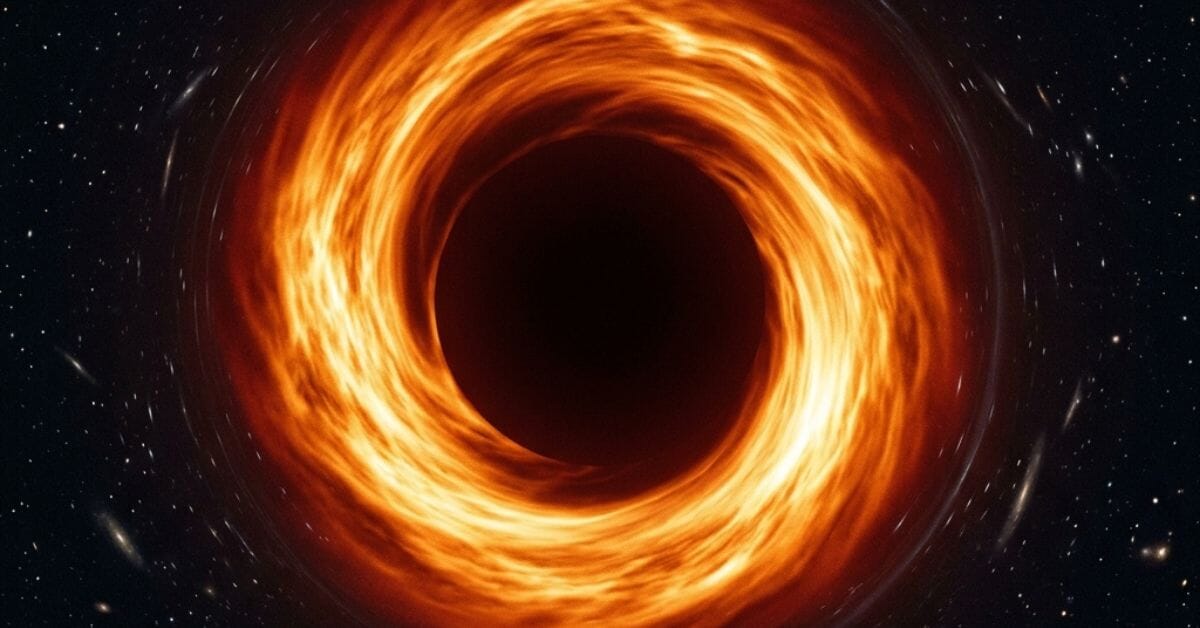
Black holes are not just strange curiosities. They help scientists test Einstein's general theory of relativity under the most extreme gravity known. They also help explain how galaxies form and evolve, since supermassive black holes and their host galaxies appear to grow together over cosmic time.
Black hole mergers, detected through gravitational waves, opened an entirely new way of observing the universe that does not rely on light at all. This field, called gravitational-wave astronomy, is still young and is expected to reveal more about the universe's most violent events in the coming decades.
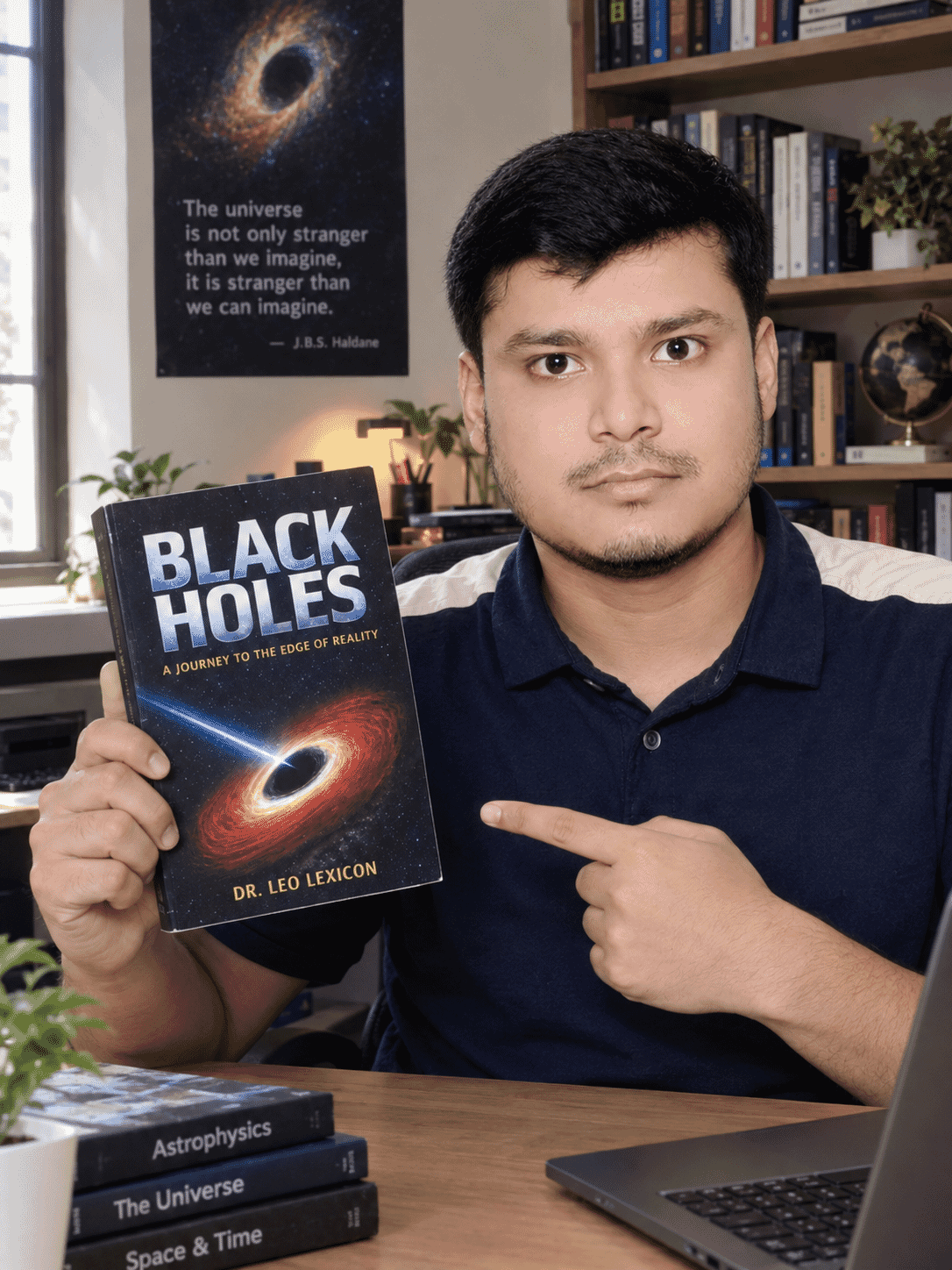
Further reading recommendation: Black Holes: A Journey to the Edge of Reality by Dr. Leo Lexicon walks through the history of black hole science, from Einstein's early skepticism to the first photographed black hole shadow, and explains concepts like Hawking radiation and gravitational-wave detection in accessible terms.
 See Price on Amazon
Black holes are regions of space where gravity is strong enough to trap light itself, and they form mainly from the collapse of massive dying stars. From the smallest stellar-mass black holes to galaxy-anchoring supermassive giants like Sagittarius A*, these objects have gone from a strange mathematical prediction to directly photographed, scientifically confirmed reality. As telescopes and gravitational-wave detectors keep improving, scientists expect to learn even more about how black holes form, grow, and shape the galaxies around them. If you want to go deeper into the physics behind them, a well-researched book or a related Science Spherex article is a great next step.
Frequently Asked Questions
What is the closest black hole to Earth?
The closest confirmed black hole candidates are thousands of light-years away. Distances are regularly refined as research improves, so always check current data from an astronomical source for the latest confirmed distance.
Can a black hole destroy Earth?
No known black hole is on a path toward our solar system. Even if one existed nearby, its gravity would only be dangerous at a close distance, similar to any other massive object.
What would happen if you fell into a black hole?
Near a small black hole, the intense difference in gravity would stretch you apart, an effect called spaghettification. Near a very large supermassive black hole, this stretching would happen more gradually.
Do black holes ever disappear?
Hawking radiation suggests black holes slowly lose mass and could eventually evaporate, but this would take far longer than the current age of the universe for any known black hole.
Is a black hole a hole in space?
No. It is an extremely dense object with immense gravity, not an empty gap or portal.
How do scientists find black holes if they cannot see them?
Scientists look for the effects a black hole has on its surroundings, such as stars orbiting an invisible object, gas heating up as it falls in, or gravitational waves from mergers.
Are black holes and wormholes the same thing?
No. They are different theoretical objects. You can read a full breakdown in this black hole vs. wormhole comparison.
How many black holes are in the universe?
Scientists estimate there could be hundreds of millions of stellar-mass black holes in the Milky Way alone, though only a small number have been confirmed through direct observation.