
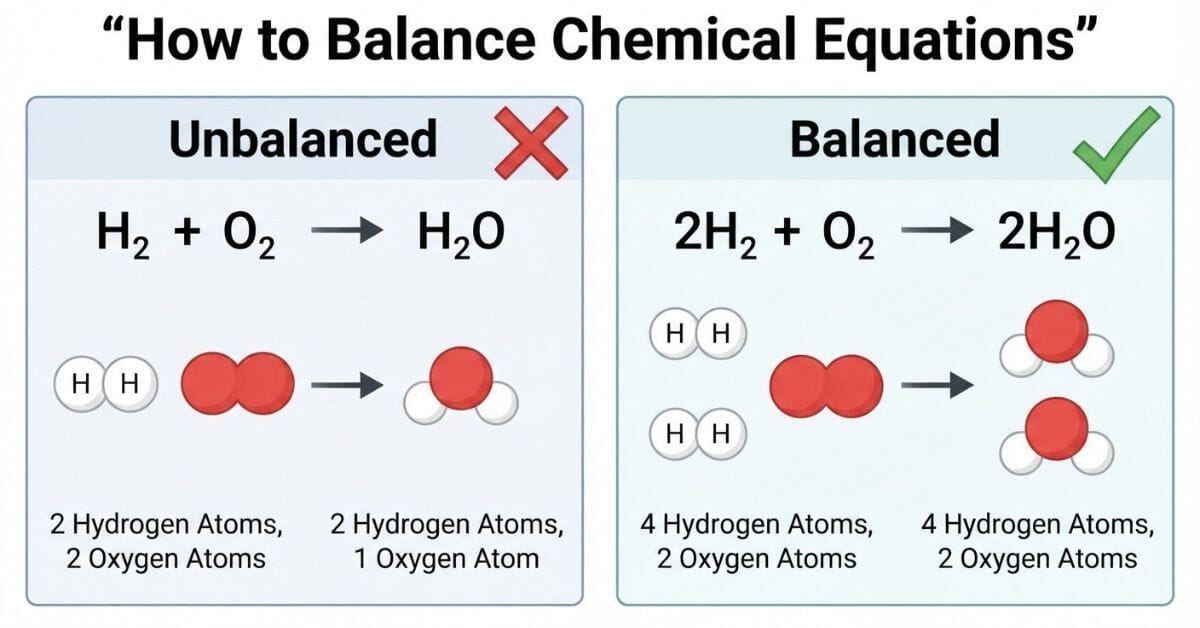
To balance a chemical equation, count the atoms of each element on both sides. Then add whole-number coefficients in front of the formulas until the counts match. Never change the small subscripts inside a formula. Balancing works because atoms are not created or destroyed in a chemical reaction. They only rearrange.
Key Takeaways
A balanced equation has the same number of each type of atom on both sides.
Change only coefficients (the big numbers in front). Never change subscripts.
Balance elements that appear in only one compound first. Leave hydrogen and oxygen for last.
Treat a polyatomic ion as one unit when it stays intact on both sides.
If you get a fraction, multiply every coefficient to clear it.
Always finish with a full atom count.
How to Balance Chemical Equations: A Simple Step-by-Step Guide
Learning how to balance chemical equations is one of the first big hurdles in chemistry. Many students find it confusing at first. It feels like a puzzle with no clear starting point.
Here is the good news. The method is simple, and it rests on one idea. Atoms cannot appear out of nowhere, and they cannot vanish. So the atoms you start with must be the atoms you end with.
This guide walks you through the whole process. You will see the steps, two different methods, real examples, common mistakes, and practice problems with answers. Grab a pencil and follow along.
What Does It Mean to Balance a Chemical Equation?
A chemical equation is a short way to describe a reaction. It uses chemical formulas to show what goes in and what comes out.
The reactants are the starting substances. They go on the left. The products are the new substances that form. They go on the right. An arrow in the middle shows the change.
Here is hydrogen reacting with oxygen to make water:
H₂ + O₂ → H₂O
Look closely. The left side has two oxygen atoms. The right side has only one. An oxygen atom has gone missing, and that cannot happen in real life. So this equation is unbalanced.
A balanced chemical equation fixes the problem. It has the same number of each atom on both sides:
2H₂ + O₂ → 2H₂O
Now both sides have four hydrogen atoms and two oxygen atoms. Nothing is lost. Nothing is added.
Coefficients vs. Subscripts
These two kinds of numbers often confuse people, so let’s separate them.
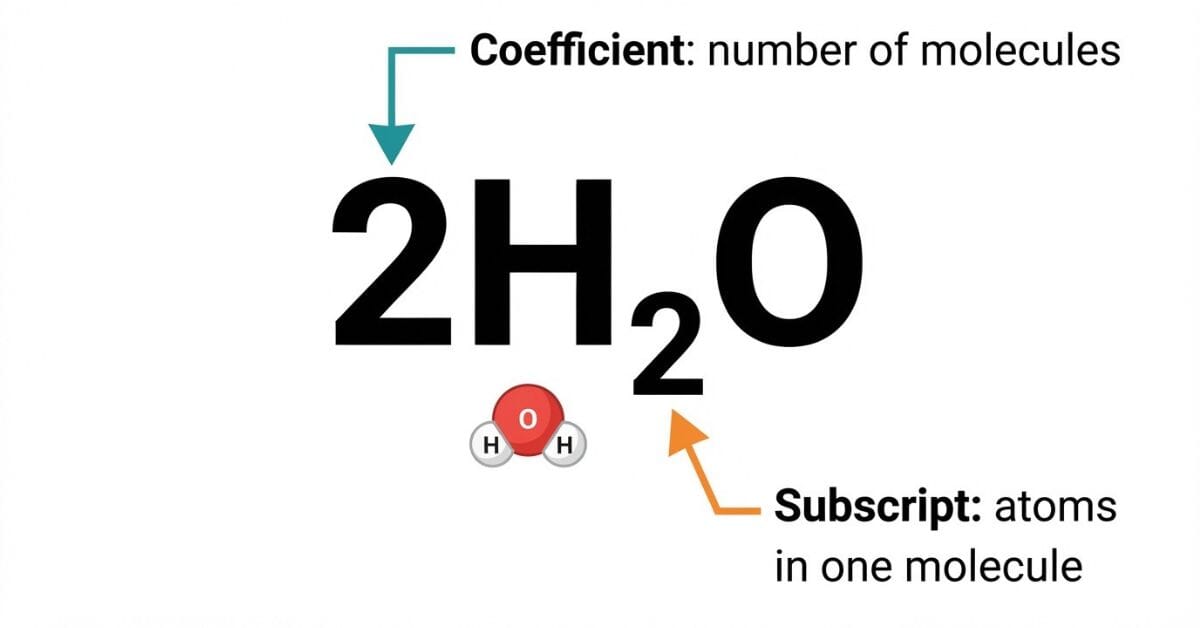
A subscript is the small number inside a formula. In H₂O, the 2 means there are two hydrogen atoms in one molecule.
A coefficient is the big number in front of a formula. In 2H₂O, the 2 means you have two whole water molecules.
When you balance an equation, you change only the coefficients. Changing a subscript changes the substance itself. H₂O is water. H₂O₂ is hydrogen peroxide. One helps you drink. The other bleaches hair. They are very different compounds.
If no coefficient is written, it means 1. So H₂O is the same as 1H₂O.
Why Chemical Equations Must Be Balanced
Balancing follows the law of conservation of mass. This law says that matter is not created or destroyed in a chemical reaction. The French chemist Antoine Lavoisier helped establish it in the late 1700s, using careful measurements of mass before and after reactions.
In practice, this means the total mass of the reactants equals the total mass of the products. The same atoms are present before and after. They just form new bonds.
Here is a quick check with real numbers. In 2H₂ + O₂ → 2H₂O, four grams of hydrogen react with about 32 grams of oxygen. The result is about 36 grams of water. The mass on each side matches.
Balanced equations also matter for real work. Chemists use them to:
Predict how much product a reaction will make
Work out how much of each reactant to mix
Check that a reaction makes sense on paper before trying it in a lab
An unbalanced equation gives wrong amounts. A balanced one gives correct ratios. That is the difference between a successful experiment and a wasted one.
A Simple Way to Think About It
Think of a pancake recipe. Say it needs 2 eggs and 1 cup of flour for each batch. If you want to make 3 batches, you need 6 eggs and 3 cups of flour. You cannot change the recipe itself. You can only change how many batches you make.
Balancing works the same way. The formulas are the recipe. They cannot change. The coefficients tell you how many “batches” of each substance you need so that no ingredient is left over or missing.
Another picture is a set of building blocks. If you take apart a toy car and build a toy boat, you still have the same blocks. You might have some in different places. But the count never changes. Atoms in a reaction behave like those blocks.
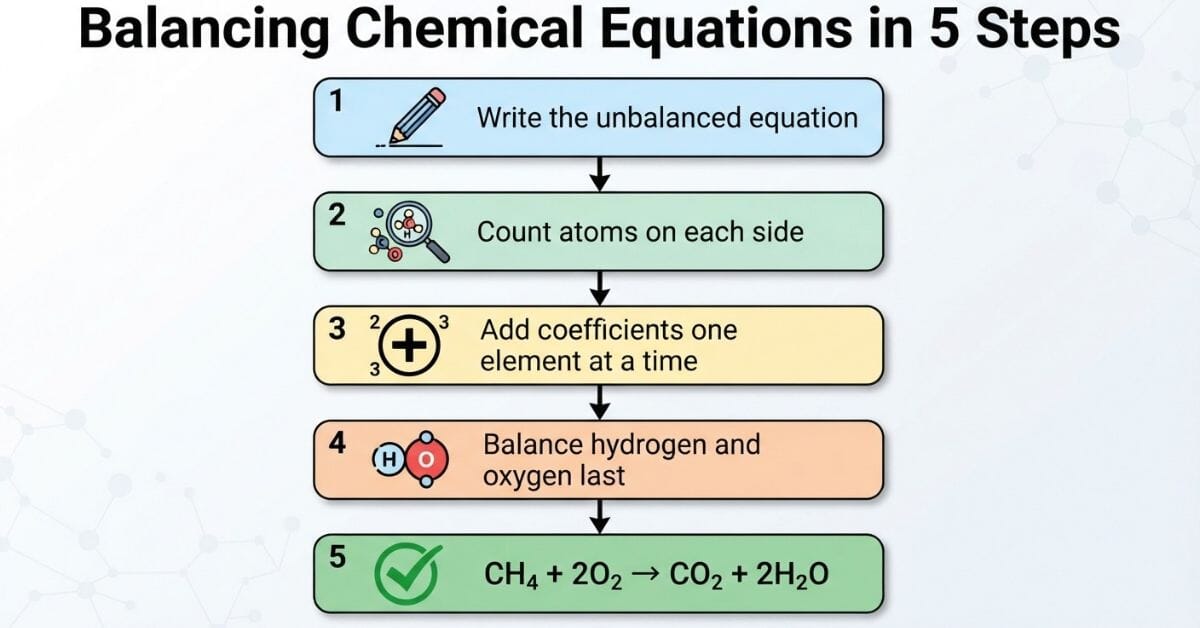
How to Balance Chemical Equations in 5 Steps
Follow these steps in order. They work for most equations you will meet in school.
Step 1: Write the unbalanced equation.
Write the correct formula for every reactant and product. Check each formula before you go on. A wrong formula can never lead to a right answer.
Step 2: Count the atoms on each side.
List every element. Count how many atoms of each are on the left and right. A small table keeps things neat.
Step 3: Add coefficients one element at a time.
Start with an element that shows up in only one reactant and one product. Add a coefficient to make that element equal on both sides.
Step 4: Balance hydrogen and oxygen last.
These two elements often appear in several compounds. If you leave them for the end, the work gets much easier.
Step 5: Check your work.
Count every atom again. If all the counts match, the equation is balanced. Then make sure the coefficients are the smallest whole numbers that work.
This approach is often called the inspection method or trial and error. It sounds casual, but it is a real, reliable technique.
Worked Examples
Example 1: Burning Methane
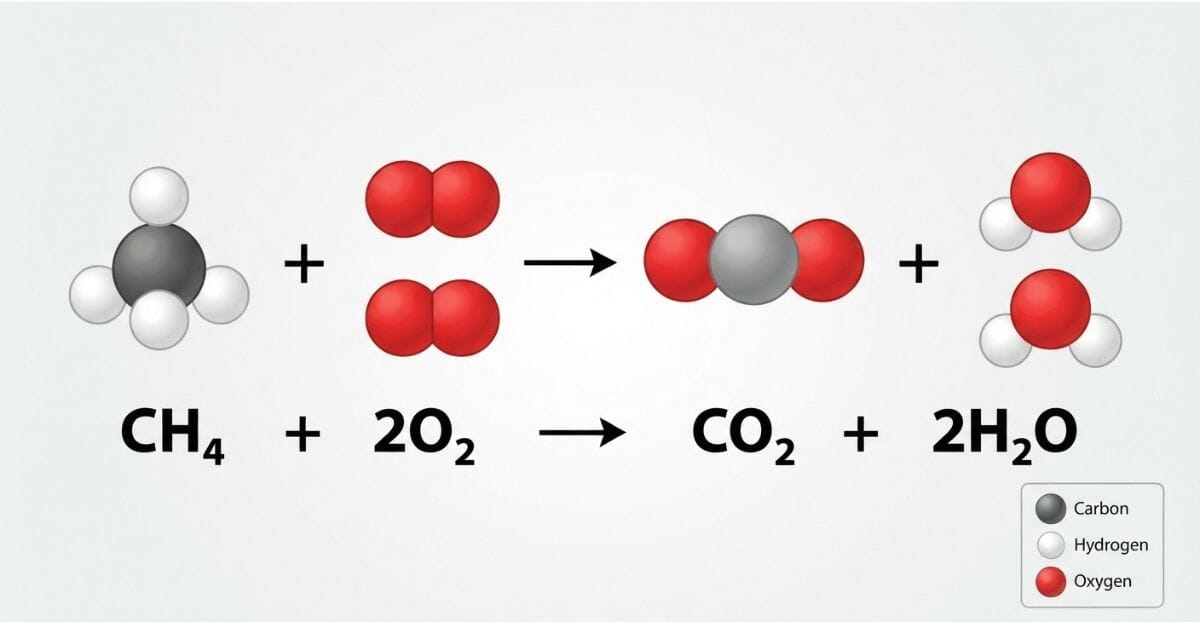
Methane (CH₄) is the main part of natural gas. It burns in oxygen to make carbon dioxide and water.
Unbalanced: CH₄ + O₂ → CO₂ + H₂O
| Element | Left | Right |
|---|---|---|
| C | 1 | 1 |
| H | 4 | 2 |
| O | 2 | 3 |
Carbon already matches. Hydrogen does not. Put a 2 in front of H₂O to get four hydrogen atoms on the right.
CH₄ + O₂ → CO₂ + 2H₂O
Now count oxygen on the right. There are two from CO₂ and two from the water. That makes four. Put a 2 in front of O₂.
CH₄ + 2O₂ → CO₂ + 2H₂O
Check: each side has 1 C, 4 H, and 4 O. It is balanced.
Example 2: Rusting Iron
Iron reacts with oxygen to make iron(III) oxide, which is rust.
Unbalanced: Fe + O₂ → Fe₂O₃
Oxygen is the tricky part. On the left, oxygen comes in pairs, so the count is always even (2, 4, 6...). On the right, Fe₂O₃ has three oxygen atoms, so a single unit gives an odd number. To fix this, find a number that both sides can reach. The lowest common multiple of 2 and 3 is 6.
Use 3 O₂ on the left for 6 oxygen atoms.
Use 2 Fe₂O₃ on the right for 6 oxygen atoms.
The right side now has four iron atoms. Put a 4 in front of Fe.
4Fe + 3O₂ → 2Fe₂O₃
Check: each side has 4 Fe and 6 O.
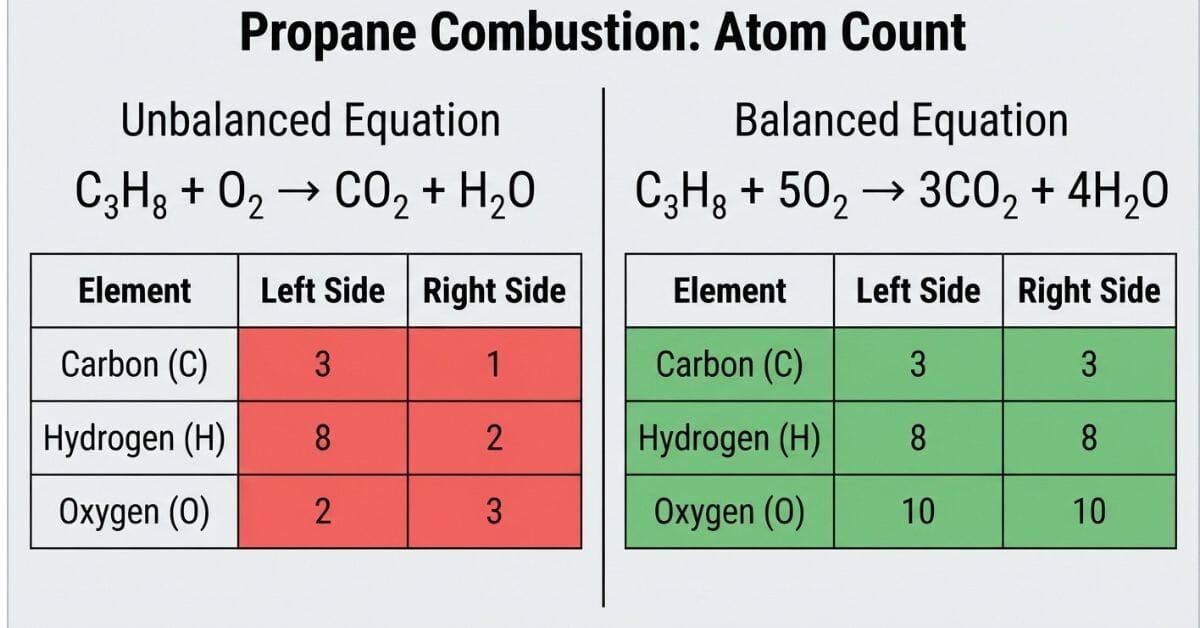
Example 3: Burning Propane
Propane (C₃H₈) is a fuel used in grills and camping stoves.
Unbalanced: C₃H₈ + O₂ → CO₂ + H₂O
Balance carbon first. Three carbon atoms on the left need 3 CO₂ on the right.
Balance hydrogen next. Eight hydrogen atoms need 4 H₂O.
Count oxygen on the right: 6 (from CO₂) plus 4 (from H₂O) equals 10.
Put a 5 in front of O₂ to get 10 oxygen atoms on the left.
C₃H₈ + 5O₂ → 3CO₂ + 4H₂O
Want more examples? Our list of 50 examples of balanced chemical equations covers many reaction types.
How to Handle Tricky Equations
When You Need a Fraction
Sometimes the only way to balance an element is with a fraction. Take ethane burning:
C₂H₆ + O₂ → CO₂ + H₂O
Balance carbon and hydrogen first:
C₂H₆ + O₂ → 2CO₂ + 3H₂O
The right side now has 7 oxygen atoms. To get 7 on the left, you need 3.5 O₂.
C₂H₆ + 3.5O₂ → 2CO₂ + 3H₂O
This is balanced, but a coefficient like 3.5 is not the standard form. Multiply every coefficient by 2:
2C₂H₆ + 7O₂ → 4CO₂ + 6H₂O
Check: 4 C, 12 H, and 14 O on each side.
Polyatomic Ions
A polyatomic ion is a group of atoms that acts like a single unit. Sulfate (SO₄²⁻) and phosphate (PO₄³⁻) are common examples.
If the same ion appears unchanged on both sides, count it as one unit. This saves a lot of time.
Try calcium hydroxide reacting with phosphoric acid:
Ca(OH)₂ + H₃PO₄ → Ca₃(PO₄)₂ + H₂O
Balance calcium first. You need 3 Ca, so use 3Ca(OH)₂. Balance phosphate next. You need 2 PO₄, so use 2H₃PO₄. Then count hydrogen and oxygen to find the water. You will need 6 H₂O.
3Ca(OH)₂ + 2H₃PO₄ → Ca₃(PO₄)₂ + 6H₂O
Check: 3 Ca, 2 P, 12 H, and 14 O on each side.
Equations With Charges
Some equations include ions with electric charge. These are called ionic equations. Here, two things must balance: the atoms and the total charge.
Take silver ions reacting with copper metal:
Ag⁺ + Cu → Ag + Cu²⁺
The atoms match, but the charge does not. The left side has a total charge of +1. The right side has +2. Put a 2 in front of Ag⁺ and Ag:
2Ag⁺ + Cu → 2Ag + Cu²⁺
Now the total charge is +2 on both sides. Full redox balancing can get more advanced. It is best to learn it after you feel confident with basic atom counting.
The Algebra Method
Some equations resist guessing. For those, algebra gives a reliable way through. It is a good backup when trial and error feels like going in circles.
Here is how it works with propane again:
C₃H₈ + O₂ → CO₂ + H₂O
Step 1. Give each substance a letter as its coefficient:
a C₃H₈ + b O₂ → c CO₂ + d H₂O
Step 2. Write one equation for each element:
Carbon: 3a = c
Hydrogen: 8a = 2d
Oxygen: 2b = 2c + d
Step 3. Set a = 1 to start. Then:
c = 3
d = 4 (because 8 = 2d)
2b = 6 + 4 = 10, so b = 5
Step 4. Put the numbers back. If any are fractions, multiply them all to get whole numbers. Here, all are whole already.
The answer is C₃H₈ + 5O₂ → 3CO₂ + 4H₂O. It matches what we found by inspection.
You do not need algebra for most school problems. But it is a great skill to have when equations get long.
Balancing Real-World Reactions
Balanced equations are not just homework. They describe things happening around you all the time.
Photosynthesis. Plants use carbon dioxide and water to make sugar and oxygen:
6CO₂ + 6H₂O → C₆H₁₂O₆ + 6O₂
Check: 6 C, 12 H, and 18 O on each side.
Making ammonia. The Haber process makes ammonia for fertilizer:
N₂ + 3H₂ → 2NH₃
Check: 2 N and 6 H on each side.
Extracting iron. Iron ore reacts with carbon monoxide to make iron metal:
Fe₂O₃ + 3CO → 2Fe + 3CO₂
Check: 2 Fe, 3 C, and 6 O on each side.
In each case, the coefficients give the exact ratio of the substances. That ratio is what lets industries and scientists plan how much of each material they need.
Common Mistakes to Avoid
Changing subscripts. This is the number one error. It changes the substance. Only change coefficients.
Forgetting to distribute a coefficient. In 3Ca(OH)₂, the 3 applies to every atom in the formula. That gives 3 Ca, 6 O, and 6 H.
Stopping too early. Balancing one element can throw off another. Always recount every element at the end.
Using wrong formulas. Check your formulas before you start. Oxygen gas is O₂, not O. Hydrogen gas is H₂.
Leaving coefficients that can be reduced. An answer like 4H₂ + 2O₂ → 4H₂O is balanced, but it is not in simplest form. Divide everything by 2 to get 2H₂ + O₂ → 2H₂O.
Thinking coefficients are grams. A coefficient counts particles, not mass. In 2H₂ + O₂ → 2H₂O, the 2 and 1 do not mean 2 grams and 1 gram. They show the ratio of molecules.
Tips for Faster Balancing
Start with the most complex formula, the one with the most atoms or elements.
Save hydrogen and oxygen for last.
Treat polyatomic ions as one unit when they stay intact.
If oxygen is stuck at an odd number, double the coefficients you already have.
Use a table to track your atom counts. It prevents silly errors.
Practice with different reaction types: combustion, synthesis, decomposition, and replacement.
A tool can also help you check your answers. Try our balanced chemical equation calculator after you attempt a problem by hand. Doing the work first is what builds the skill.
If you got stuck on problem 6, you are in good company. It looks like the ethane problem. The oxygen count ends up odd, so you double everything to get whole numbers.
To balance a chemical equation, make sure each element has the same atom count on both sides. Do this by adding coefficients, never by changing subscripts. Count your atoms, balance one element at a time, save hydrogen and oxygen for last, and check your final answer.
The method works because of the law of conservation of mass. Atoms rearrange in a reaction, but they are never lost. Once you see that, balancing stops feeling like guesswork.
Your next step is simple. Try the practice problems above, then test yourself on a few more. A few equations a day will make the steps feel natural.
FAQs
What is the first step in balancing a chemical equation?
Write the correct, unbalanced equation. Then count the atoms of each element on both sides.
Why can’t I change subscripts when balancing?
Subscripts are part of a compound’s identity. Changing them creates a different substance. Coefficients only change how many molecules you have.
What is the easiest way to balance chemical equations?
Balance one element at a time. Start with elements that appear in only one compound on each side. Leave hydrogen and oxygen for last.
Can I use fractions as coefficients?
You can use them while working. The final answer should use the smallest whole numbers. Multiply every coefficient by the denominator to clear a fraction.
What is the difference between a balanced and an unbalanced equation?
A balanced equation has equal atom counts for every element on both sides. An unbalanced equation does not.
How do I write a balanced chemical equation from words?
Turn each substance name into its formula. Write the reactants on the left and the products on the right, with an arrow between them. Then balance the atoms.
Do state symbols like (g) and (l) affect balancing?
No. State symbols show whether a substance is a gas (g), liquid (l), solid (s), or dissolved in water (aq). They do not change the atom count.
Does the total mass stay the same in a balanced equation?
Yes. The mass of the reactants equals the mass of the products. This is the law of conservation of mass.
What do I do when oxygen will not balance?
Check whether the count is odd on one side. If so, double the coefficients you already have, or use a half coefficient and then multiply everything by 2.
Is there a quick way to check my answer?
Make a table of each element with a left column and a right column. If every row shows equal numbers, you are done.
Still guessing the coefficients?
64 Balanced Chemical Equations: A Complete Student-Friendly Guide. Learn and review 64 balanced chemical equations with clear, easy-to-follow examples. Perfect for students, revision and quick chemistry reference.
- 64worked examples
- 58practice questions with answers
- 4balancing methods
- 4week study plan
- An atom tally table that proves every answer
- Moles, limiting reactants, net ionic equations and redox basics
- Printable cheat sheets and exam-day tactics
- Complete PDF eBook with instant digital access
First 20 buyers: launch price
$9.99 $3.99
Use coupon code FIRST20 at checkout
Secure PayPal payment · Digital PDF eBook
Need help after payment? Email contact@sciencespherex.com with your payment details and we will help you receive your eBook.