
Wondering how to time travel to the past in real life? The honest answer is that nobody has done it, and no known technology can. But the physics behind the question is wild, and parts of it are real. Here's what science actually says, in plain English.
Time travel to the future, on the other hand, already happens in tiny amounts. GPS satellite clocks run about 38 microseconds per day faster than clocks on the ground once relativity is accounted for, and engineers have to correct for it. Going backward is a much harder puzzle, so let's start with the short answer.
Table of Contents
How to Time Travel to the Past in Real Life: The Short Answer
You can't, at least not with anything we know how to build today. Physics doesn't strictly forbid travel to the past, but every proposed method needs exotic conditions, like huge amounts of negative energy, that nobody has come close to producing. For now, backward time travel is a theory, not a technology.
That doesn't make the question silly. Einstein's general relativity, published in 1915, treats time as something that can bend and stretch. A few solutions to its equations even allow loops in time. Whether those solutions describe anything real is still an open question. If you want the broader debate first, we cover whether time travel is possible in a separate guide.
Spacetime Explained: Why Time Isn't a Straight Line
General relativity treats space and time as one four-dimensional fabric called spacetime. Mass and energy bend that fabric, and the bending changes how time passes. Clocks run slower in strong gravity, for example.
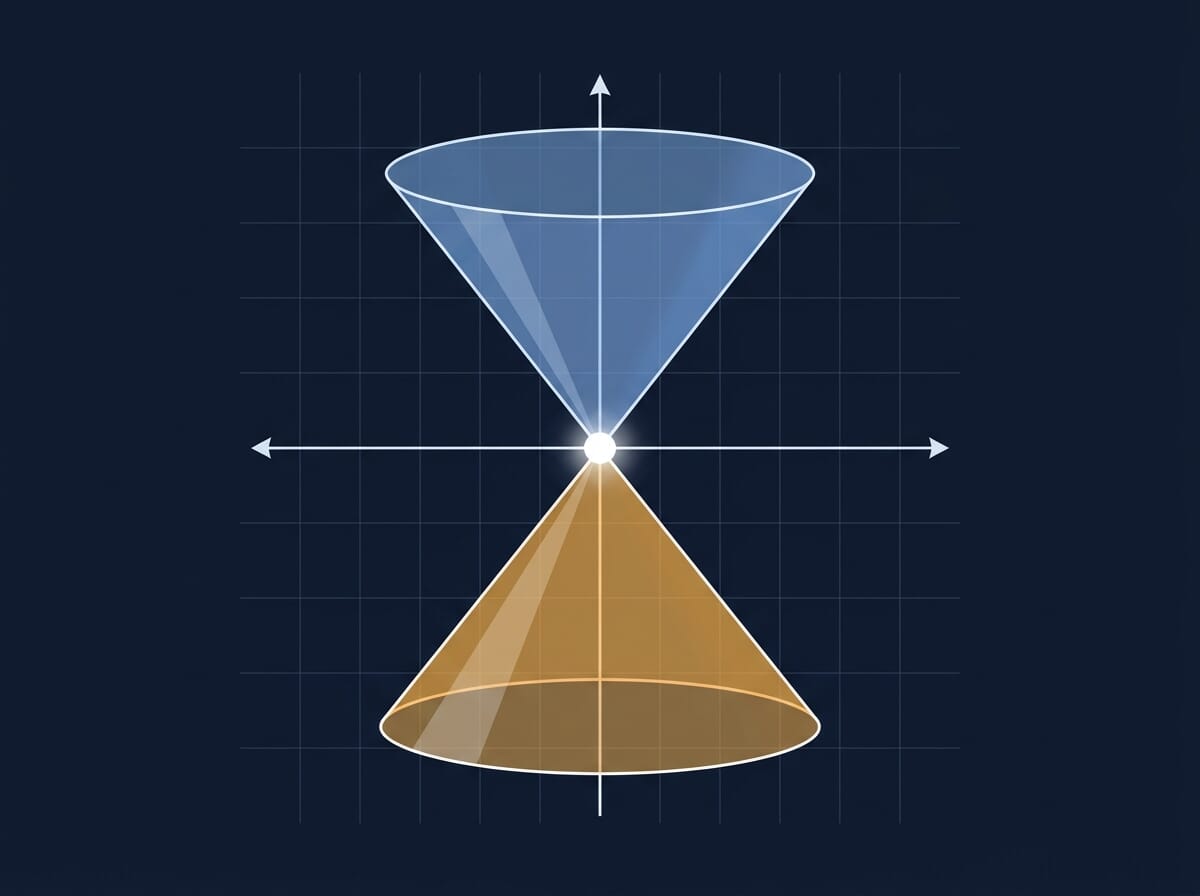
Physicists draw this with a light cone diagram. Your position is a dot. Everything that could ever affect you sits in the cone below it (your past). Everything you could ever reach sits in the cone above it (your future). The cone's edges trace the path of light.
Normally, those cones point straight up the time axis. Going to the past would mean moving down that axis, which in ordinary spacetime would need faster-than-light travel. Every idea in the next section tries the same trick: bend spacetime so hard that the cones tip over and a "forward" path loops back to an earlier moment.
How to Travel Back in Time: The Three Theoretical Routes
Physicists have found three main ideas on paper. None has been built or observed.
| Idea | How it would work | Biggest obstacle |
|---|---|---|
| Traversable wormhole | A tunnel between two points in spacetime, with one mouth made to age differently from the other | Staying open seems to need exotic matter with negative energy |
| Tipler cylinder | A dense, rapidly spinning cylinder drags spacetime around it into time loops | The original version needs infinite length |
| Gödel universe | A rotating universe (1949 solution) where closed time loops exist | Astronomers see no sign that our universe rotates like that |
Wormholes get the most attention. The Einstein-Rosen bridge idea dates to 1935. In 1988, Kip Thorne and colleagues showed that a traversable wormhole could, in theory, work as a time machine. "In theory" is doing a lot of work there.
Time Dilation and Telescopes: How We Already Touch the Past
Two real effects come close to time travel, even though neither sends you backward.
Telescopes show the past. Light takes time to travel. Sunlight reaches us in about 8 minutes, and the light we see from the Andromeda Galaxy left it roughly 2.5 million years ago. Looking at the sky is looking back in time.
Time dilation slows clocks. Clocks tick slower at high speed and in strong gravity. In 1971, the Hafele-Keating experiment flew atomic clocks on airliners and measured tiny differences that matched relativity. Cosmonaut Sergei Krikalev, after about 803 days in orbit, effectively landed roughly 0.02 seconds into Earth's future.
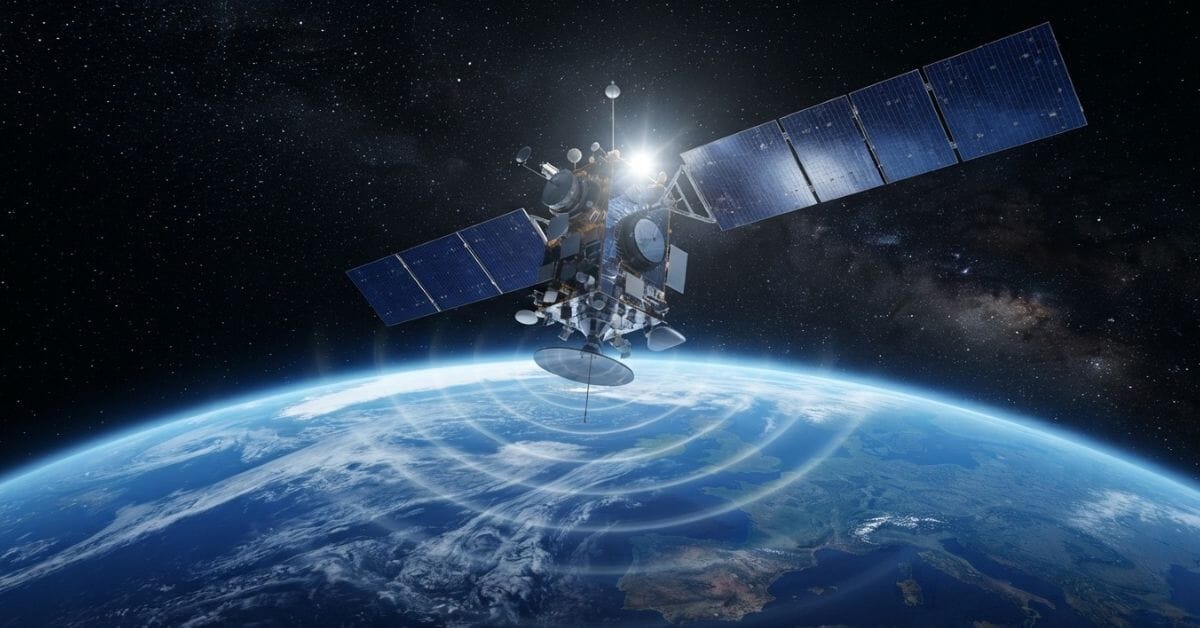
GPS depends on it. Satellite clocks are corrected for relativity so your phone's location stays accurate. Without the fix, errors would grow fast.
That's forward travel and sightseeing. Neither lets you revisit or change the past.
Why Nobody Has Built a Time Machine Yet
Even on paper, the hard parts stack up fast:
Exotic matter. Holding a wormhole open needs negative energy density. Tiny amounts show up in quantum effects like the Casimir effect, but nobody knows how to make or store enough.
Extreme scale. Proposed machines need extraordinary amounts of mass or energy, far beyond anything we can build.
Physics may block it. In 1992, Stephen Hawking proposed the chronology protection conjecture: the idea that the laws of physics stop time machines from ever forming. It's unproven, but physicists take it seriously.
Paradoxes. The grandfather paradox asks what happens if you stop your own grandparents from meeting. The Novikov self-consistency principle suggests events could never contradict themselves, but that's a proposal, not a proven rule.
If you want the engineering angle, we dig into whether a time machine is possible to build in its own article.
FAQs About Traveling to the Past
How can I time travel to the past?
You can't right now. No known method works, and every theoretical route needs exotic matter or conditions beyond today's technology. The closest real thing is looking at distant objects, since their light left long ago and shows how they looked in the past.Has anyone ever time traveled?
Only in tiny forward steps. Astronauts and satellite clocks run slightly differently from clocks on Earth because of speed and gravity, measured in fractions of a second. Nobody has gone backward, and there's no credible evidence of anyone doing so.Would going to the past create a paradox?
It could, and that's one reason many physicists doubt backward travel is allowed. The grandfather paradox asks what happens if you prevent your own birth. One proposed fix, the Novikov self-consistency principle, says events can't contradict themselves.Can black holes let you travel in time?
Black holes slow time for outside observers near them, but they don't send you to the past. Standard black holes crush matter at their center. Some mathematical solutions hint at tunnels, but nothing observed suggests a usable route.How to Go Back Into Time Today: A Simple Decision Guide
Here's an if/then guide for what you can actually do:
If you want to see the past, look through a telescope or browse space-telescope images. You're seeing old light.
If you want to feel the past, visit museums, read primary sources, or explore historical reconstructions.
If you want to understand how backward travel might work, start with spacetime and light cone diagrams, then read about wormholes.
If someone is selling a real time machine, walk away. Nothing in known physics supports it.
So, how to time travel to the past in real life? Right now, you can't, but you can explore the idea through real science. If you're more curious about where time is heading than where it's been, read our take on whether the world is ending.